
As climate change accelerates and construction demands surge in 2026, the need for sustainable building solutions has never been more urgent. Timber construction is at the forefront of this transformation, blending tradition with innovation to create eco-friendly, high-performance buildings.
This guide will show you how timber construction is revolutionising sustainable building. You will discover its unique benefits, the latest construction methods and materials, key sustainability standards, the regulatory landscape, and emerging trends for 2026.
Timber is not just making a comeback; it is essential for achieving net zero targets and expanding woodland cover across the UK. By reducing embodied carbon by up to 60% and storing carbon long-term, timber construction offers a practical path to greener, smarter projects.
Explore this comprehensive guide to make informed, sustainable choices for your next development.
The Rise of Timber Construction: Context and Benefits
Timber construction is rapidly transforming the UK’s built environment, driven by a surge in demand for sustainable solutions. As the government pushes for greener infrastructure, timber is emerging as a cornerstone of modern building strategies. Its versatility and low carbon footprint are helping the sector address urgent environmental challenges while meeting construction needs for 2026.
Timber in the 2026 Built Environment
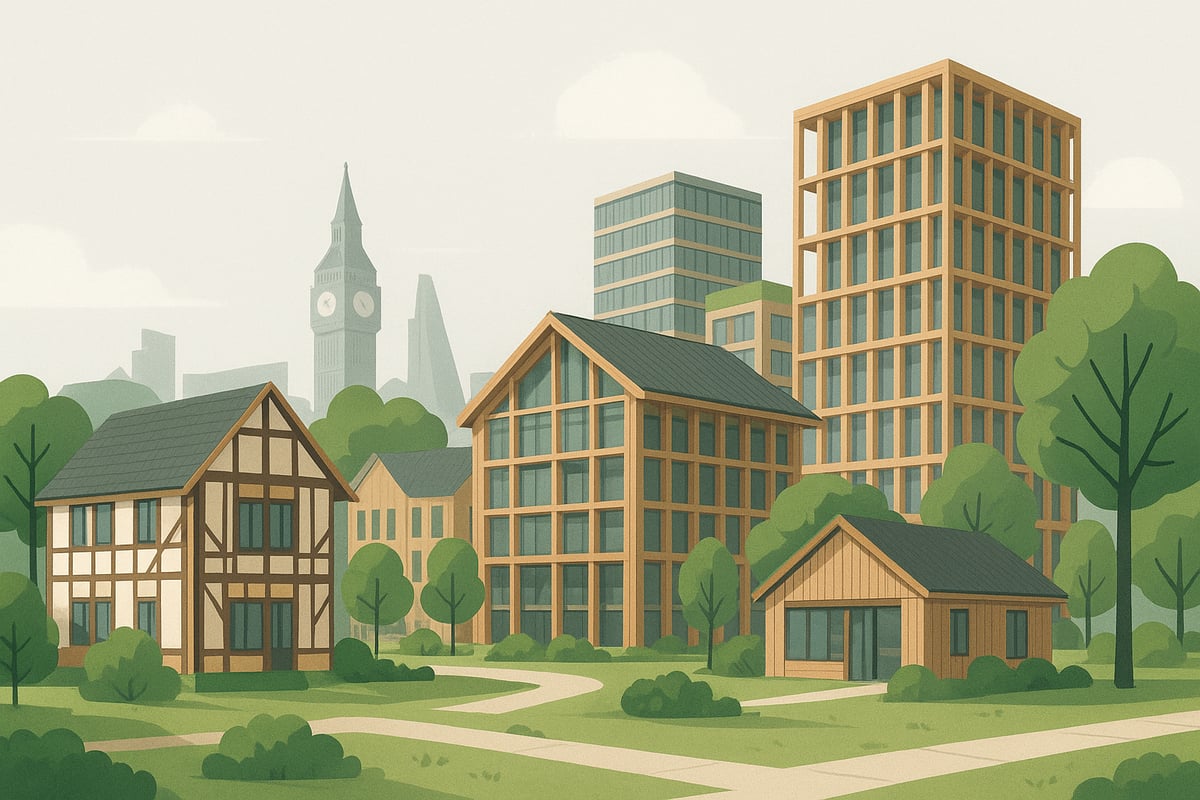
Timber construction is gaining significant ground in the UK market. In 2019, only 9% of new builds in England used timber frames, but adoption rates are climbing steadily as sustainability becomes a top priority. Government targets are ambitious: woodland cover is set to increase from 14.5% in 2024 to 16.5% by 2050, with incentives to encourage responsible timber use.
This shift is not just about policy, but about practical solutions for net zero. Timber construction supports the circular economy by reducing waste and promoting renewable resources. With growing pressure to decarbonise the built environment, timber is now at the forefront of innovative urban design.
Environmental and Economic Advantages
One of the most compelling benefits of timber construction is its ability to store carbon throughout a building’s life. Timber acts as a natural carbon sink, capturing emissions that would otherwise contribute to climate change. Compared to conventional materials, timber construction can cut embodied carbon by 20 to 60%, as confirmed by the UK government’s own roadmap.
The economic advantages are equally notable. Timber construction creates green jobs across forestry, processing, and building sectors. Investments in timber supply chains stimulate local economies and support rural communities. For a detailed look at these advantages, see Timber-framed building benefits.
Timber’s Legacy and Modern Relevance
The UK’s relationship with timber construction stretches back centuries. Historic landmarks like Westminster Hall showcase the durability and architectural beauty of traditional timber roofs. Today, advances in engineering and treatment methods have given timber a modern resurgence.
Modern timber construction is not limited to residential projects. It is now used in commercial and public buildings, offering durability and design flexibility. The legacy of timber in the UK demonstrates its ability to adapt and thrive in new contexts, bridging tradition and innovation.
Key Arguments and Insights
Timber construction stands out for its renewable nature. Timber is sourced from managed forests, supporting sustainable cycles and biodiversity. Its inherent thermal and acoustic properties improve comfort and energy efficiency in buildings.
Offsite manufacturing techniques make timber construction cost-effective and quick to assemble. Projects benefit from reduced site disruption, less waste, and predictable timelines. Timber construction also integrates well with other eco-friendly materials, maximising sustainability outcomes.
Examples and Data
Scotland sets a high bar, with 92% of new homes using timber frames. This benchmark highlights the scalability of timber construction across the UK. Case studies reveal that public buildings and low-rise housing developments are increasingly turning to timber for its performance and sustainability.
Data shows that timber construction not only reduces waste but also improves site safety due to precise offsite manufacturing. Successful projects across the UK demonstrate that timber construction delivers on both ecological and economic goals, making it a key player in the future of sustainable building.
Timber Construction Methods and Materials in 2026
The landscape of timber construction in 2026 is dynamic and diverse, driven by sustainability, innovation, and a renewed appreciation for wood’s potential. Modern methods blend traditional craftsmanship with cutting-edge technology, supporting a wide range of building types and scales.
Structural Timber Systems
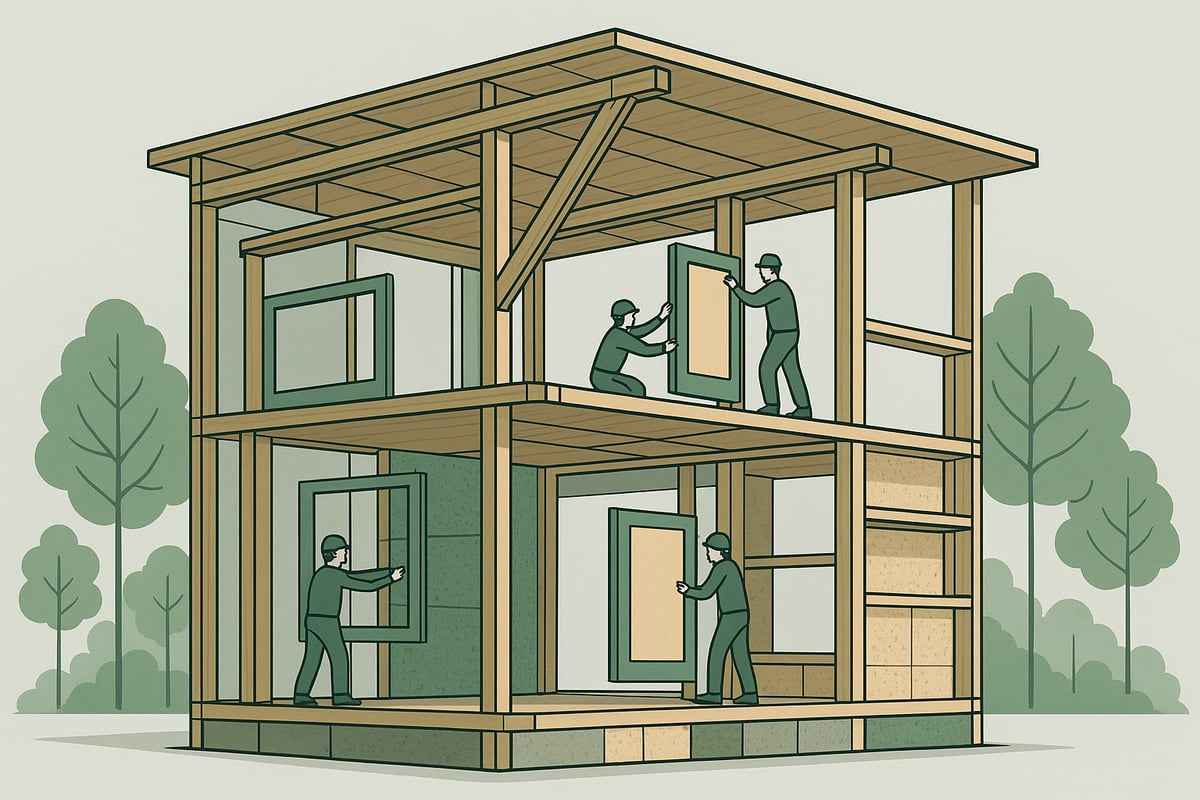
Structural timber systems form the backbone of contemporary timber construction. Open panel timber frames, made in factories for accuracy, allow rapid on-site assembly and flexible layouts. Closed panel systems take this further, arriving pre-insulated and pre-finished to reduce time and waste.
Post and beam construction offers design freedom, using robust timber columns and beams to create open, adaptable spaces. Trussed rafter roofs, a staple since the 1960s, are now engineered for improved environmental performance and longevity.
For a deeper dive into these approaches, see this guide to timber frame construction methods.
Engineered Mass Timber Products
Engineered mass timber products are transforming timber construction, enabling larger and taller buildings. Cross-Laminated Timber (CLT) panels provide strength and stability, making multi-storey projects possible and supporting wide, open interiors.
Glued laminated timber (glulam) and laminated veneer lumber (LVL) bring consistency and flexibility, adapting to complex architectural designs. These products dramatically lower embodied carbon compared to steel or concrete, and their precision manufacturing ensures minimal material waste.
Mass timber’s versatility is central to the next generation of sustainable buildings, from offices to schools.
Modular and Volumetric Timber Systems
Modular and volumetric timber systems represent the future of rapid, efficient timber construction. Entire rooms or building sections are made offsite, complete with insulation, windows, and internal finishes. This process slashes on-site build times, cuts waste, and improves quality control.
Applications range from affordable housing developments to hotels and educational facilities. The controlled factory setting also enhances worker safety and ensures consistent standards.
By combining modular innovation with sustainable materials, these systems answer both environmental and economic demands.
Non-Structural and Hybrid Uses
Timber construction extends beyond primary structural elements. Timber is widely used in non-structural applications such as flooring, partitions, doors, windows, stairs, and cladding. Wood fibre insulation and panel products like OSB, MDF, and plywood contribute to improved energy efficiency and indoor comfort.
Hybrid construction, blending timber with steel or concrete where advantageous, delivers the best of both worlds: reduced carbon footprint, design flexibility, and robust performance.
These approaches broaden timber’s role in diverse building types.
Material Sourcing and Quality
Sustainable sourcing is non-negotiable in modern timber construction. Timber must be certified by the Forest Stewardship Council (FSC) or Programme for the Endorsement of Forest Certification (PEFC), ensuring responsible forestry practices.
Advances in timber treatment have enhanced durability and fire resistance, extending the lifespan of timber elements. Quality control, from sawmill to site, guarantees consistent performance and compliance with regulations.
Local sourcing of timber further reduces transport emissions, supporting both environmental goals and regional economies.
Examples and Data
Recent years showcase timber construction’s impact. Large office buildings now use CLT for entire structural frames, achieving significant carbon savings. Modular timber housing projects can be completed in weeks rather than months, making them ideal for urgent housing needs.
Offsite timber construction has been shown to reduce site waste by over 50 percent and improve health and safety. In Scotland, more than 90 percent of new homes use timber frames, setting a benchmark for the rest of the UK.
Timber construction in 2026 is defined by adaptability, sustainability, and proven performance.
Sustainability Standards, Certifications, and Best Practices
Sustainability sits at the heart of modern timber construction. In 2026, rigorous standards and certifications are essential to guarantee that every project delivers environmental, social, and economic benefits. Understanding these frameworks helps architects, developers, and self-builders make informed, responsible choices that stand up to scrutiny.
Key Sustainability Certifications
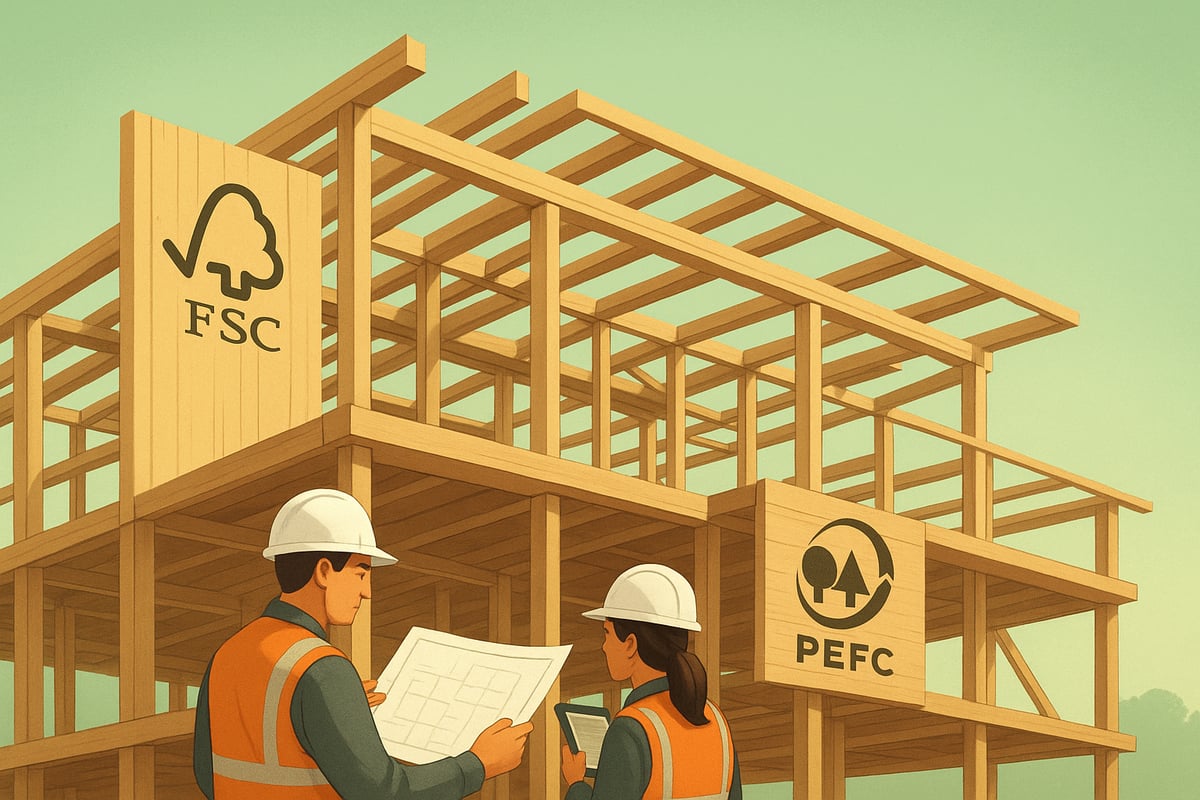
Certifications are vital for verifying responsible sourcing in timber construction. The Forest Stewardship Council (FSC) and Programme for the Endorsement of Forest Certification (PEFC) are the two leading schemes. Both ensure that timber comes from well-managed forests, protecting biodiversity and local communities.
Environmental Product Declarations (EPDs) add another layer of transparency. EPDs provide clear data on the environmental impact of timber products, from harvest to end-of-life. Specifying FSC or PEFC certified products, alongside EPDs, is now common practice for sustainable builds.
| Certification | Focus | Benefits |
|---|---|---|
| FSC | Responsible forest management | Global recognition, social & eco |
| PEFC | Sustainable forestry | Widely adopted, supply chain |
| EPD | Product lifecycle impact | Quantified carbon, comparability |
Whole Life Carbon Assessment
Whole life carbon assessment is a cornerstone of sustainable timber construction. Standards like BS EN 15978 and BS EN 15804 guide how to measure and report embodied carbon throughout a building’s lifecycle.
The Built Environment Carbon Database (BECD) is a valuable resource for benchmarking the carbon impact of timber construction projects. Assessing carbon from raw material extraction to demolition enables teams to set reduction targets and demonstrate performance credibly.
Early adoption of these assessment tools ensures timber construction meets or exceeds the latest climate commitments, while supporting transparent reporting for clients and stakeholders.
Circular Economy and End-of-Life Considerations
Timber construction naturally supports the circular economy. Timber components can be designed for reuse, disassembly, or recycling at the end of a building’s life. Offcuts and waste are often repurposed as bioenergy, further reducing environmental impact.
Designing for disassembly is an emerging trend. By planning joints and connections for easy separation, future adaptations or reuses become straightforward. This approach maximises the long-term value and flexibility of timber construction.
Prioritising circular strategies not only reduces waste but also supports the UK’s zero-waste and net zero ambitions.
Best Practice Approaches
Best practices in timber construction combine material efficiency, smart design, and advanced building techniques. Hybrid construction, which integrates timber with other low-carbon materials, offers strength and flexibility for complex projects.
Optimising layouts for minimal waste and selecting high-performance insulation are crucial. For guidance on sustainable insulation options specifically suited to timber construction, see Insulating timber frame walls.
Energy efficiency is another key focus. High airtightness, careful detailing, and renewable energy integration help timber buildings meet or exceed regulatory standards.
Examples and Data
Recent case studies highlight the benefits of timber construction in real-world settings. Some buildings store up to 400 percent more carbon than equivalent masonry structures, according to Future Homes Hub.
Data from RICS shows that whole life carbon strategies, combined with responsible sourcing, can cut emissions dramatically. UK initiatives are driving zero-waste construction, setting a benchmark for the industry.
These examples prove that adopting sustainability standards and best practices in timber construction is not just possible, but essential for the future of building.
Regulatory Landscape and Safety Considerations
The regulatory environment for timber construction in the UK is evolving rapidly. With growing adoption of sustainable building methods, clear guidance is essential. Navigating compliance, safety, and insurance requirements is key to unlocking the potential of timber construction in 2026.
UK and EU Regulatory Developments
The UK government has prioritised timber construction in its drive towards net zero targets. As outlined in the Timber in Construction Roadmap 2025, new policies support greater use of timber in both residential and commercial buildings.
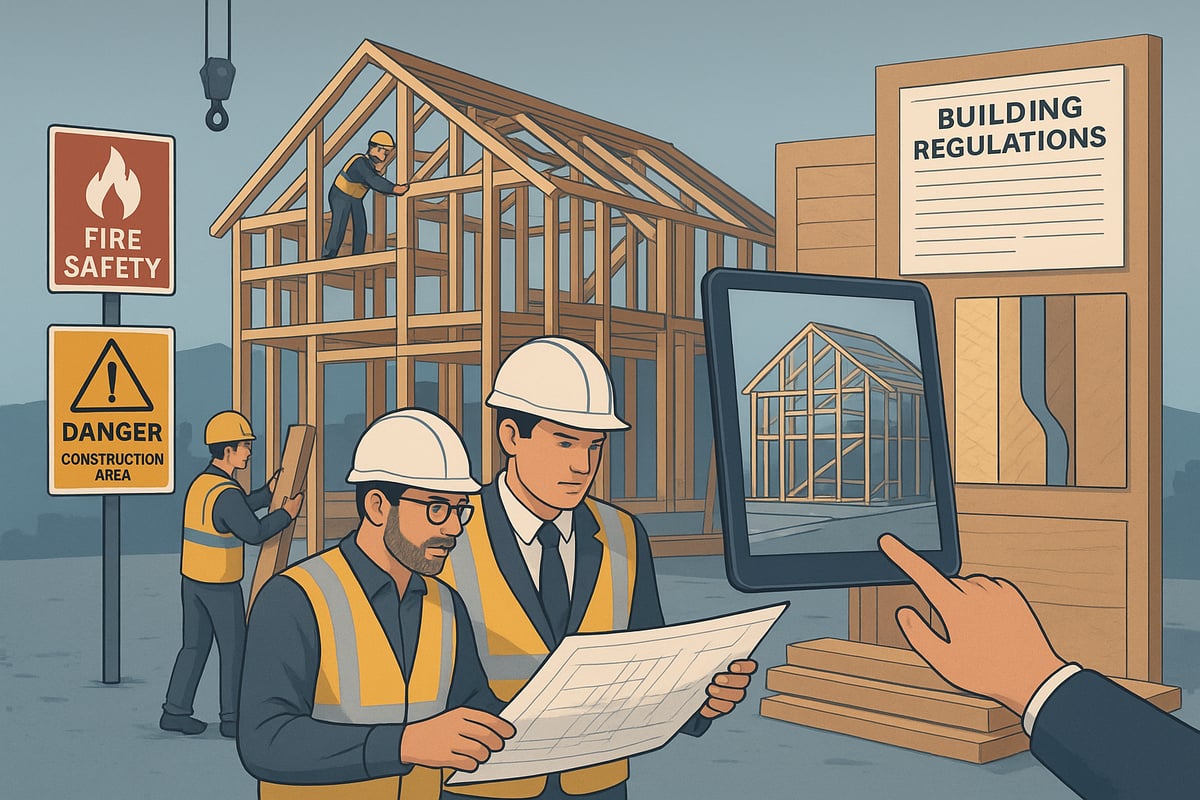
Revisions to UK Building Regulations for 2026 focus on structural integrity, fire safety, and embodied carbon. Standards for engineered timber such as CLT and glulam in mid and high-rise buildings continue to evolve. Collaboration with EU partners ensures alignment on certification and sustainability benchmarks.
Fire safety remains a central concern. Updated codes require rigorous testing of mass timber systems and the use of advanced fire-resistant materials. These changes help ensure that timber construction meets or exceeds the latest safety standards, building trust with stakeholders.
Insurance, Lending, and Warranty Issues
Access to insurance and finance has historically been a barrier for timber construction. Lenders and insurers have raised concerns about durability, fire risk, and long-term maintenance. In response, the industry is developing enhanced warranties and robust certification schemes.
Collaboration between timber suppliers, developers, and insurers is improving risk assessment methods. Comprehensive data on performance and longevity is helping to build confidence. Clear documentation and third-party certification are now prerequisites for securing favourable insurance and lending terms.
Warranty providers are also adapting to the specifics of timber construction. They are recognising the benefits of offsite manufacturing, quality control, and new treatment methods that extend the life of timber elements. This progress supports wider adoption in both the private and public sectors.
Building Performance and Compliance
Meeting UK Building Regulations is essential for all timber construction projects. Part L sets standards for energy efficiency, while Part B focuses on fire safety. Engineered timber products must demonstrate compliance through rigorous testing and certification.
Digital tools like Building Information Modelling (BIM) and Environmental Product Declarations (EPDs) are streamlining compliance processes. These technologies make it easier to model, document, and verify building performance throughout the project lifecycle.
Regular monitoring and quality assurance at every stage help ensure that timber construction achieves its sustainability and safety goals. Early engagement with building control officers and fire engineers is strongly recommended to avoid costly delays.
Health, Safety, and Comfort
Timber construction contributes to healthy indoor environments. Natural wood materials regulate humidity and improve air quality. Buildings benefit from excellent thermal and acoustic properties, supporting occupant comfort and wellbeing.
Safety standards address not only fire and structural risks but also the comfort of residents and workers. Enhanced acoustic insulation and fire-resistant finishes are now standard in most timber construction projects. These features help meet strict UK and EU requirements for modern buildings.
Attention to detail during design and assembly ensures that timber construction delivers both safety and superior living conditions. Ongoing maintenance and monitoring further support long-term health and comfort.
Examples and Data
Recent timber construction projects in the UK highlight successful navigation of regulatory and safety challenges. For instance, several mid-rise offices and schools have achieved full compliance with updated fire safety and energy standards.
Data from industry reports show improved insurance terms and greater willingness among lenders to support timber construction. The adoption of digital compliance tools has reduced errors and streamlined approvals.
These successes demonstrate that with the right expertise and preparation, timber construction can meet the highest standards of safety, performance, and sustainability required for 2026 and beyond.
Step-by-Step Guide to Sustainable Timber Construction in 2026
Embarking on a sustainable timber construction project in 2026 requires a clear process, attention to detail, and an understanding of best practices from planning through to post-occupancy. This step-by-step guide walks you through each stage, ensuring your project delivers on sustainability, compliance, and performance.
Step 1: Planning and Design
The foundation of any successful timber construction project is a robust planning and design phase. Begin by selecting a site that supports your sustainability aims, considering factors such as solar orientation, access, and proximity to local timber suppliers.
Engage with architects and engineers who have proven experience in timber construction. Their expertise will help you make informed choices about structure, detailing, and integration with other building systems. Early collaboration ensures your design maximises the benefits of timber, from embodied carbon reduction to rapid build times.
Conduct sustainability assessments at the concept stage. Use carbon modelling tools to forecast the environmental impact of your build. Evaluate how the building’s shape, layout, and orientation enhance its passive performance. This phase is critical for setting clear sustainability targets, including energy use, carbon storage, and flexibility for future adaptation.
- Choose a site optimised for timber construction.
- Appoint a design team with timber expertise.
- Set sustainability targets and use carbon modelling tools.
- Ensure early coordination with planners and local authorities.
Step 2: Sourcing Sustainable Timber
Sourcing is at the heart of sustainable timber construction. Always specify FSC or PEFC-certified timber to guarantee responsible forest management and transparent supply chains. Ask suppliers for chain of custody documentation, confirming the timber’s origin and compliance with environmental standards.
Prioritise local or domestic timber where possible. Reducing transport distances cuts carbon emissions and supports the UK’s growing forestry sector. Assess the environmental credentials of each supplier, including their approach to biodiversity, harvesting, and replanting.
Work with your design team to match timber species and grades to their intended use. Consider durability, strength, and availability. Early engagement with suppliers ensures material lead times align with your construction schedule.
- Specify FSC/PEFC-certified timber in all contracts.
- Request full chain of custody documentation.
- Choose local suppliers to lower transport emissions.
- Match timber species to structural and aesthetic requirements.
Step 3: Selecting Construction Methods
Choosing the right construction method shapes your project’s sustainability, cost, and timeline. Assess whether panelised systems, post-and-beam, mass timber, or modular solutions fit your needs. Each approach offers unique advantages for timber construction.
Panelised and modular systems allow for offsite manufacturing, improving precision and reducing waste. Mass timber products such as CLT and glulam enable larger spans and multi-storey designs. For bespoke or hybrid projects, consult specialists to optimise the mix of timber and other materials.
Balance your decision based on project size, design complexity, and sustainability goals. Hybrid timber frame solutions can offer the best of both worlds in terms of performance and flexibility.
- Evaluate the pros and cons of each method.
- Consider hybrid solutions for complex or high-rise projects.
- Factor in speed, cost, and carbon savings.
- Collaborate with engineers to ensure structural integrity.
Step 4: Construction and Assembly
Efficient construction and assembly are central to successful timber construction. Offsite manufacturing delivers components with high precision, reducing site waste and construction time. Upon delivery, ensure safe handling and storage to protect timber from moisture.
Onsite, follow established protocols for rapid, accurate assembly. Timber frames and modules can often be erected in days, minimising disruption and improving site safety. Quality control is vital at every stage: inspect connections, seals, and weatherproofing before progressing.
A typical project timeline might look like this:
| Phase | Duration | Key Actions |
|---|---|---|
| Offsite manufacture | 6 weeks | Fabrication and pre-assembly |
| Site preparation | 2 weeks | Groundworks and foundations |
| Delivery & assembly | 2 weeks | Frame erection and weatherproofing |
| Fit-out & finishing | 2 weeks | Services, interiors, landscaping |
- Store timber components under cover until use.
- Follow manufacturer’s assembly guidelines.
- Inspect connections and seals during installation.
- Document progress and quality checks at each stage.
Step 5: Ensuring Safety and Compliance
Safety and compliance are paramount in timber construction. All works must meet UK Building Regulations, especially Parts B (fire safety) and L (energy efficiency). Engage with building control officers early to clarify requirements and agree on fire protection strategies.
Prepare thorough documentation for insurance, warranties, and regulatory approval. This should include structural calculations, fire safety details, and environmental credentials. Digital tools such as BIM can streamline compliance and record-keeping.
A sample documentation checklist:
- Structural calculations and engineer’s sign-off
- Fire safety strategy and materials data
- Chain of custody and certification records
- Whole life carbon assessment
- As-built drawings and maintenance plan
Establish a monitoring and maintenance regime to preserve durability and performance. Regular inspections help identify and address issues such as moisture ingress or wear.
- Liaise with building control and insurers from the outset.
- Prepare and maintain comprehensive documentation.
- Implement ongoing monitoring and maintenance plans.
Step 6: Maximising Sustainability and Lifecycle Value
To unlock the full sustainability potential of timber construction, design for adaptability, reuse, and recycling from day one. Modular elements and demountable connections allow future repurposing or easy disassembly at the end of life.
Consider the circular economy: timber can be reused in new builds or processed for bioenergy. For a deeper understanding of timber’s end-of-life potential, the Probabilistic Assessment of Engineered Timber Reusability explores how engineered timber performs after moisture exposure, a key factor in long-term sustainability.
Integrate renewable energy systems and smart building technologies to boost operational efficiency. Monitor performance post-occupancy to ensure your building meets its sustainability targets. For more on timber’s role in circular construction and embodied carbon reduction, see Circular Construction: Building for a Greener UK.
- Design for disassembly and flexibility.
- Specify reusable, recyclable timber products.
- Monitor building performance and adapt as needed.
- Leverage industry research on timber reuse and circularity.
By following these steps, you can ensure your timber construction project in 2026 is not only compliant and cost-effective but also a benchmark for sustainability and innovation.
Innovations and Future Trends in Timber Construction
The landscape of timber construction is evolving rapidly, driven by cutting-edge technology, shifting regulations, and a growing focus on sustainability. As we look ahead to 2026 and beyond, the sector is poised to deliver more efficient, resilient, and environmentally responsible buildings than ever before.
Emerging Technologies and Digital Tools
Digital design is transforming timber construction, making complex structures more feasible and efficient. Building Information Modelling (BIM) enables teams to collaborate on detailed models, reducing errors and streamlining workflows. Robotics and automated machinery in offsite manufacturing have improved precision, allowing for the rapid production of timber components with minimal waste.
Smart sensors now monitor timber buildings in real time, tracking humidity, structural integrity, and energy use. This data-driven approach helps optimise maintenance and extend the life of timber structures. As timber construction gains prominence, these technologies will play a key role in enhancing both safety and sustainability.
Hybrid and High-Rise Timber Buildings
Hybrid systems are expanding the possibilities for timber construction, combining timber frames with steel or concrete for added strength and flexibility. These solutions are unlocking taller and more complex buildings, from mid-rise offices to residential towers.
The UK is home to several notable examples, with hybrid timber structures achieving new heights in both design and sustainability. For those interested in innovative approaches, Hybrid timber frame solutions offer insight into how this method blends the best of multiple materials. As regulations adapt, expect to see even more ambitious projects utilising hybrid timber construction.
Bio-Based Materials and Timber Alternatives
Innovation in timber construction extends beyond traditional wood. Bio-based materials, such as wood fibre insulation and engineered timber composites, are reducing reliance on carbon-intensive products. These materials offer excellent thermal performance and can be integrated with renewable energy systems for truly sustainable buildings.
Engineered products like cross-laminated timber and advanced glulam are enabling larger spans and greater design flexibility. Research into new bio-composites promises even more durable and sustainable options. Timber construction is increasingly defined by its adaptability and continuous material innovation.
Policy and Market Drivers
Government policy is a major catalyst for the growth of timber construction. Incentives for low-carbon buildings, green finance, and stricter embodied carbon targets are encouraging developers to choose timber. The UK’s net zero ambitions, alongside woodland expansion schemes, are creating a fertile market for sustainable construction.
Industry standards, such as those recognised by the RIBA UK Awards – Sustainability Guide, reinforce the value of timber construction in achieving measurable sustainability outcomes. Market demand from architects and clients for eco-friendly solutions will continue to drive innovation in this space.
Skills, Training, and Workforce Development
The shift toward timber construction is creating new opportunities and challenges for the workforce. There is a growing need for skilled timber framers, designers, and installers who understand modern methods and sustainability best practices.
Industry-led training programmes are expanding, focusing on digital tools, offsite manufacturing, and hybrid construction techniques. Collaboration between educational institutions and industry bodies is essential to build a workforce equipped for the future of timber construction. As the sector grows, investment in skills will underpin quality, safety, and innovation.
If you’re inspired by the potential of timber construction for a more sustainable future, you’re not alone—many are turning to timber for its environmental benefits, design flexibility, and long-term value. At Acorn to Oak Framing, we combine traditional craftsmanship with cutting-edge techniques, tailoring every project to your needs while meeting the highest sustainability standards. Whether you’re dreaming of a bespoke home, a new workspace, or a unique extension, our team is here to guide you from planning through to completion. Ready to take the next step toward a greener build? BUILD NOW


