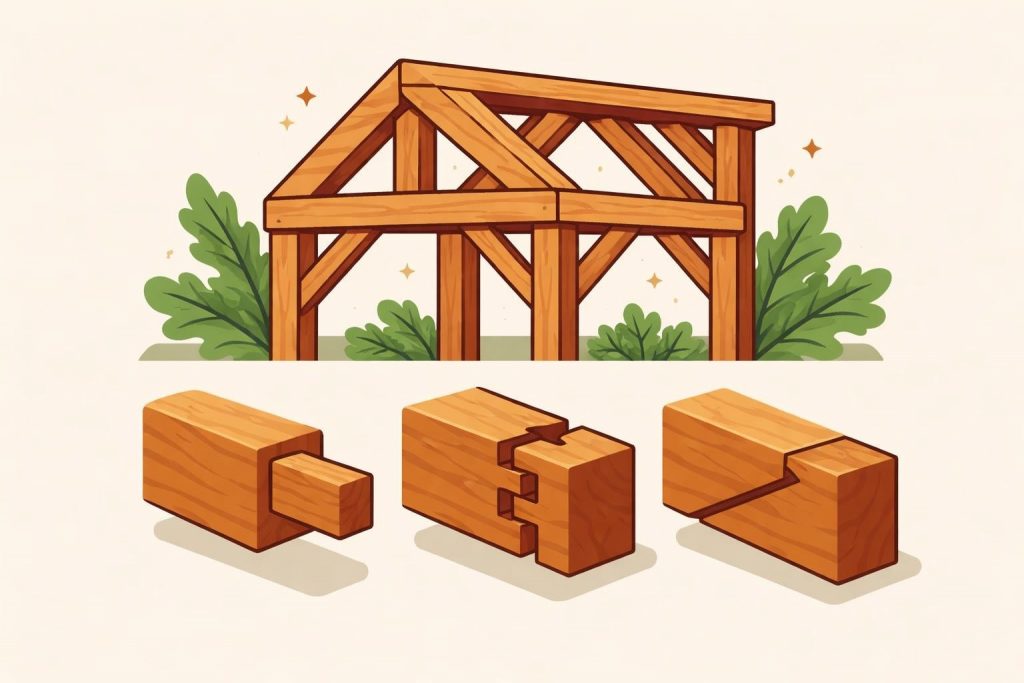
The foundation of any exceptional timber frame structure lies in the precision and strength of its joinery. Whether constructing a traditional oak garage or a contemporary timber frame house, understanding timberframe joints is essential for creating structures that stand the test of time. These intricate connections, refined over centuries of craftsmanship, transform individual timber members into cohesive, resilient frames capable of supporting substantial loads whilst accommodating the natural movement of wood. For property owners considering a timber frame project, comprehending the various joint types and their applications provides valuable insight into the craftsmanship and engineering excellence that defines quality construction.
The Engineering Foundation of Timberframe Joints
Traditional timberframe joints rely on fundamental mechanical principles rather than modern fasteners. The interlocking nature of these connections distributes loads efficiently across multiple surfaces, creating compression zones that strengthen under weight.
Primary Load Transfer Mechanisms:
- Compression bearing between perpendicular surfaces
- Shear resistance through cross-grain timber sections
- Friction generated by tight-fitting components
- Mechanical interlocking through shaped profiles
The Timber Framers Guild technical bulletins provide extensive research on moment connections and design stresses, offering valuable guidance for both traditional craftspeople and modern structural engineers. This knowledge proves particularly crucial when designing bespoke timber buildings that must meet contemporary building regulations whilst maintaining traditional aesthetic qualities.
Structural Performance and Load Distribution
Engineering analysis of timberframe joints reveals complex stress patterns that vary significantly between joint types. Research indicates that properly executed joints can achieve remarkable strength-to-weight ratios, with some traditional connections outperforming modern alternatives in specific applications.
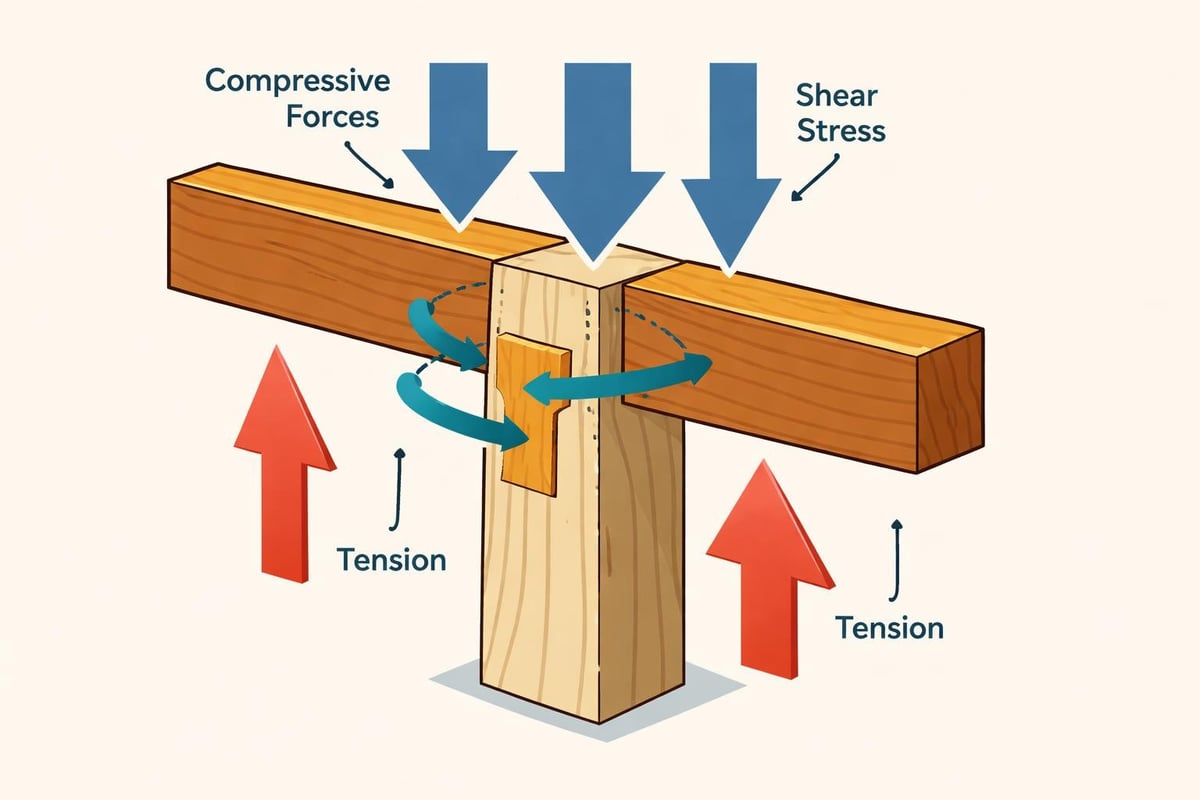
The behaviour of joints under sustained loading differs markedly from performance under sudden impact or lateral forces. Understanding these characteristics enables designers to select appropriate joint types for specific structural requirements, whether for a single-bay garage or a five-bay building.
Traditional Joint Types in Oak Framing
The mortise and tenon joint represents the cornerstone of timber frame construction, providing exceptional strength and versatility. This fundamental connection consists of a projecting tenon cut on one timber member that fits precisely into a mortise cavity in another. The precision required for optimal performance demands exceptional craftsmanship, with typical tolerances measured in millimetres.
| Joint Type | Primary Application | Strength Characteristics | Complexity Level |
|---|---|---|---|
| Through Mortise & Tenon | Main frame connections | Excellent compression, good shear | Moderate |
| Blind Mortise & Tenon | Secondary connections | Good compression, moderate shear | Moderate |
| Dovetail | Tie beam connections | Exceptional tension resistance | High |
| Scarf Joint | Lengthening timbers | Maintains continuity | Very High |
| Bridle Joint | Corner assemblies | Good lateral stability | Moderate |
Mortise and Tenon Variations
The versatility of mortise and tenon joints allows numerous adaptations for specific structural requirements. Through tenons extend completely through the receiving timber, allowing for wedging that increases joint tightness as the structure settles. This technique proves particularly valuable in oak frame construction, where timber movement remains a consideration throughout the structure's lifespan.
Pegged mortise and tenon joints incorporate oak dowels driven through both members, creating a mechanical lock that prevents separation under tension loads. The placement, diameter, and number of pegs require careful calculation based on timber dimensions and anticipated loads.
Key Design Considerations:
- Tenon thickness typically equals one-third of timber width
- Mortise depth should exceed tenon length by 3-6mm
- Peg placement must avoid splitting along grain lines
- Shoulder cuts require precise perpendicular surfaces
Specialist Joints for Complex Structures
Dovetail joints excel in applications requiring resistance to tensile forces, making them ideal for tie beam connections and situations where members might otherwise pull apart. The dovetail’s characteristic shape, wider at the end than at the base, creates a mechanical lock that strengthens under load. This joint type appears frequently in high-quality timber frames where structural integrity cannot be compromised.
The bridle joint, though less common than mortise and tenon connections, offers distinct advantages in specific applications. This versatile joint combines elements of both mortise and tenon and lap joints, providing excellent resistance to racking forces whilst maintaining visual appeal.
Scarf Joints for Extended Members
When timber length requirements exceed available stock dimensions, scarf joints enable the creation of longer members without compromising structural integrity. These sophisticated connections distribute loads across extended surfaces, maintaining strength comparable to continuous timber sections.
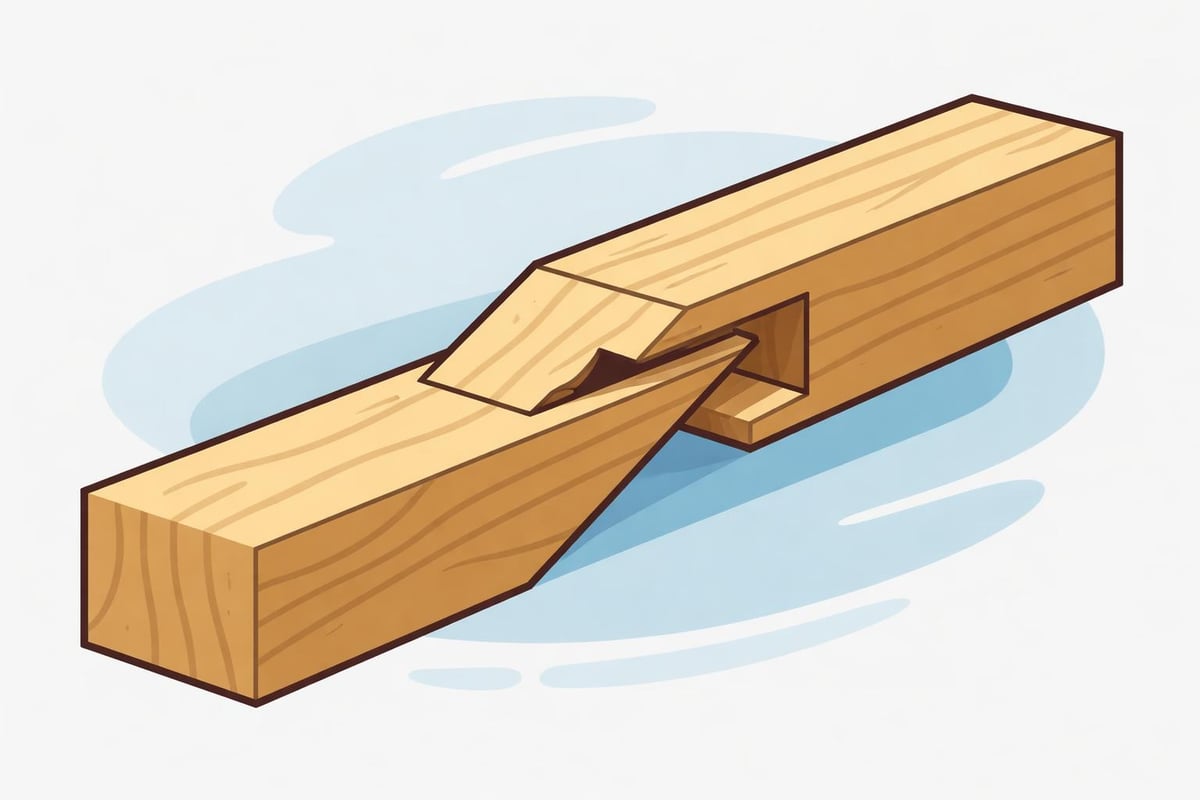
Traditional scarf configurations include:
- Splayed scarf with wedges – Provides exceptional compression resistance
- Stopped splayed scarf – Prevents lateral displacement whilst maintaining strength
- Edge-halved scarf – Suitable for secondary members with moderate loads
- Bridled scarf – Combines scarf geometry with bridle joint principles
Modern Engineering Considerations
Contemporary timber frame design incorporates advanced structural analysis techniques whilst maintaining traditional joinery principles. The ICC NTA engineering resources examine how mortise and tenon joints integrate with modern building systems, including structural insulated panels that enhance thermal performance.
Computer modelling enables precise stress analysis, revealing load paths and identifying potential failure modes before construction begins. This technology allows timber framers to optimise joint dimensions for specific applications, ensuring adequate safety factors whilst minimising material waste.
Hybrid Construction Approaches
Modern timber frame hybrid construction often combines traditional joinery with contemporary fastening systems where appropriate. Strategic use of steel plates, bolts, and engineered connectors can enhance performance in high-stress areas whilst preserving the aesthetic and structural benefits of traditional timberframe joints throughout the majority of the structure.
| Connection Method | Advantages | Typical Applications | Considerations |
|---|---|---|---|
| Traditional Joints | Authentic appearance, proven durability | Primary frame members | Requires skilled craftsmanship |
| Steel Brackets | High load capacity, precise engineering | Beam-to-post connections | May affect aesthetics |
| Timber Connectors | Enhanced shear capacity | Heavy-loaded joints | Must prevent moisture ingress |
| Hybrid Systems | Optimises each method's strengths | Complex junction points | Requires careful detailing |
Fabrication Precision and Quality Control
The creation of exceptional timberframe joints demands meticulous attention to detail throughout the fabrication process. Traditional hand-cutting techniques, whilst time-intensive, allow craftspeople to adjust for timber irregularities and achieve optimal fit. Modern CNC machinery offers remarkable precision for certain joint types, though research on adapting traditional joints for CNC fabrication reveals ongoing challenges with tightly coupled connections.
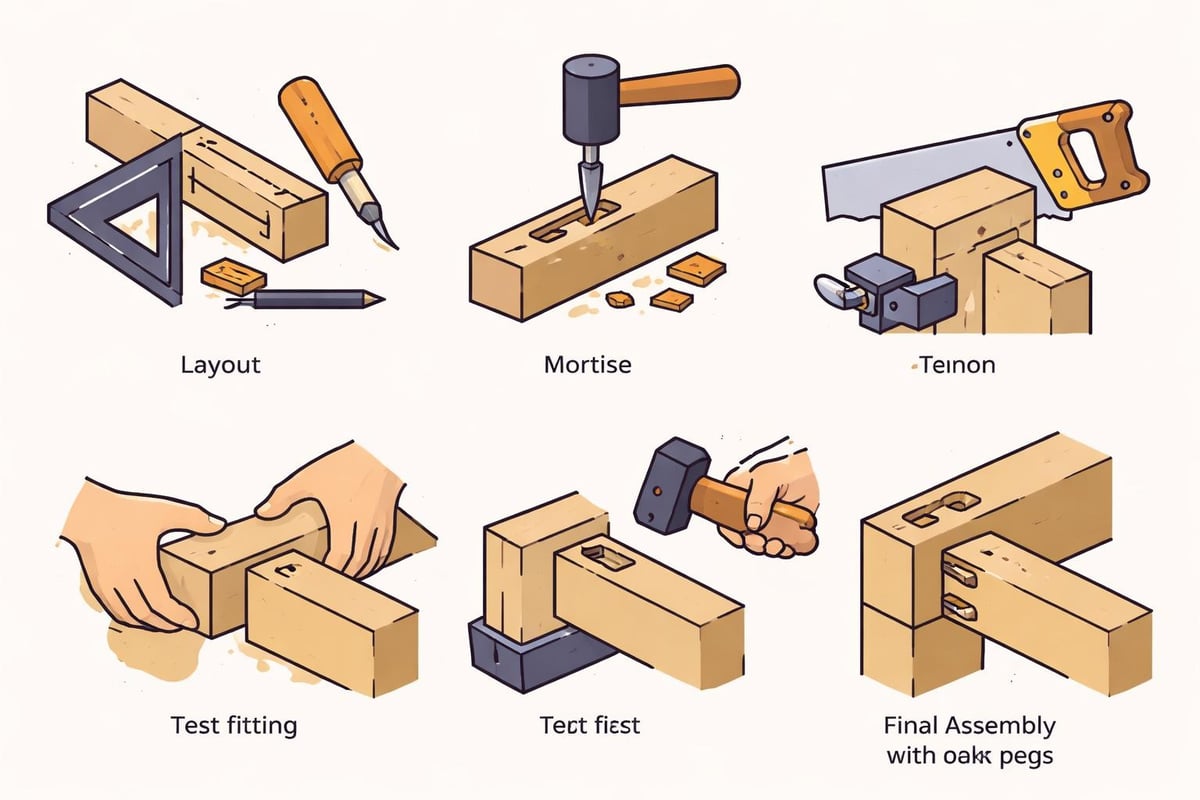
Critical Fabrication Steps:
- Accurate timber dimension measurement accounting for moisture content
- Precise marking using traditional layout techniques
- Controlled cutting maintaining perpendicular surfaces
- Test fitting with gradual material removal for perfect tolerances
- Final assembly with appropriate tensioning methods
Quality oak timber selection significantly impacts joint performance. Grain orientation, growth ring density, and moisture content all influence how joints behave under load and throughout seasonal cycles. Working with sustainably sourced oak ensures consistent material properties essential for reliable joint performance.
Testing and Verification
Before incorporating new joint designs into structural applications, rigorous testing validates performance characteristics. Historical research, such as the National Park Service’s guide to traditional timber joinery, provides baseline data for traditional joint capacities, whilst modern research on timber frame connections examines strength and stiffness characteristics under controlled conditions.
Full-scale testing programmes subject joints to representative loading conditions, measuring deflection, ultimate capacity, and failure modes. This empirical data informs design decisions and establishes appropriate safety factors for various applications.
Joint Selection for Specific Applications
Choosing appropriate timberframe joints requires careful consideration of structural requirements, aesthetic preferences, and practical construction constraints. A three-bay building demands different joint strategies compared to a raised eaves structure, with varying spans and load distributions influencing optimal joint selection.
Primary frame connections carrying substantial vertical loads typically employ through mortise and tenon joints, often with double pegging for additional security. Secondary members may utilise simpler connections where loads permit, balancing structural adequacy with fabrication efficiency.
Specialised Structure Requirements
Gazebos and pergolas present unique joinery challenges due to their open nature and exposure to weather from multiple directions. Joints in these structures must accommodate greater moisture variation whilst maintaining structural integrity and visual appeal. Similarly, garage buildings require joints capable of supporting roof loads whilst allowing for large open spans.
The integration of modern elements, such as glazing systems or insulated panels, necessitates careful joint detailing to maintain weather-tightness whilst preserving traditional construction principles. This balance between innovation and tradition defines contemporary timber frame excellence.
Preservation and Long-Term Performance
Properly executed timberframe joints can perform admirably for centuries, as evidenced by numerous historic structures throughout the UK. However, long-term durability requires attention to factors beyond initial fabrication quality. Moisture management remains paramount, as cycles of wetting and drying can weaken joints through wood movement and potential decay.
Long-Term Performance Factors:
- Adequate roof overhangs protecting wall frames from weather
- Proper ground clearance preventing moisture wicking
- Ventilation allowing seasonal moisture equilibration
- Regular inspection identifying early signs of deterioration
- Prompt repair of damaged or degraded components
Research examining timber-concrete composite structures provides insights into joint behaviour under sustained loading, revealing how connection details influence overall structural performance over extended periods. This knowledge applies equally to traditional all-timber construction, informing maintenance strategies and renovation approaches.
Renovation and Repair Considerations
When historic timber frames require intervention, understanding original joint configurations proves essential for sympathetic repair. Modern timber framers must balance preserving authentic joinery with ensuring contemporary structural performance standards. Sometimes, discrete reinforcement maintains historic fabric whilst meeting current building regulations.
Advanced analysis techniques, including research on framed timber joint behaviour, inform repair strategies by identifying stress concentrations and predicting how interventions affect overall structural behaviour. This scientific approach complements traditional craftsmanship, ensuring interventions enhance rather than compromise structural integrity.
Design Integration and Architectural Expression
Beyond their structural function, timberframe joints contribute significantly to a building's aesthetic character. Exposed joinery celebrates craftsmanship whilst creating visual interest through the interplay of timber members and connection details. Strategic joint placement can emphasise architectural features, drawing attention to key structural elements or creating rhythm across building elevations.
Contemporary timber frame design often features joints as deliberate design elements rather than concealing them behind finishes. This approach honours traditional building methods whilst creating spaces with distinctive character and warmth. The visibility of joints also facilitates inspection and maintenance, practical benefits that complement aesthetic considerations.
Design Expression Opportunities:
- Feature joints at prominent locations highlighting craftsmanship
- Consistent joint styling creating visual coherence
- Peg placement following deliberate geometric patterns
- Timber species selection emphasising grain patterns at connections
- Strategic lighting highlighting three-dimensional joint geometry
The relationship between joint selection and overall structural expression requires consideration during early design stages. Frame home construction planning should integrate joinery decisions with spatial arrangements, ensuring structural logic and architectural intent align harmoniously.
Mastering timberframe joints represents the culmination of centuries of craft knowledge combined with modern engineering understanding. These sophisticated connections transform individual timber members into cohesive structures capable of lasting generations whilst providing distinctive architectural character. Whether you're planning a traditional oak garage, a contemporary timber extension, or a complete timber frame house, understanding joint principles ensures your project achieves both structural excellence and aesthetic appeal. Acorn to Oak Framing combines traditional joinery expertise with modern design capabilities to create exceptional timber frame structures across the UK, ensuring every connection meets the highest standards of craftsmanship and engineering performance.


