
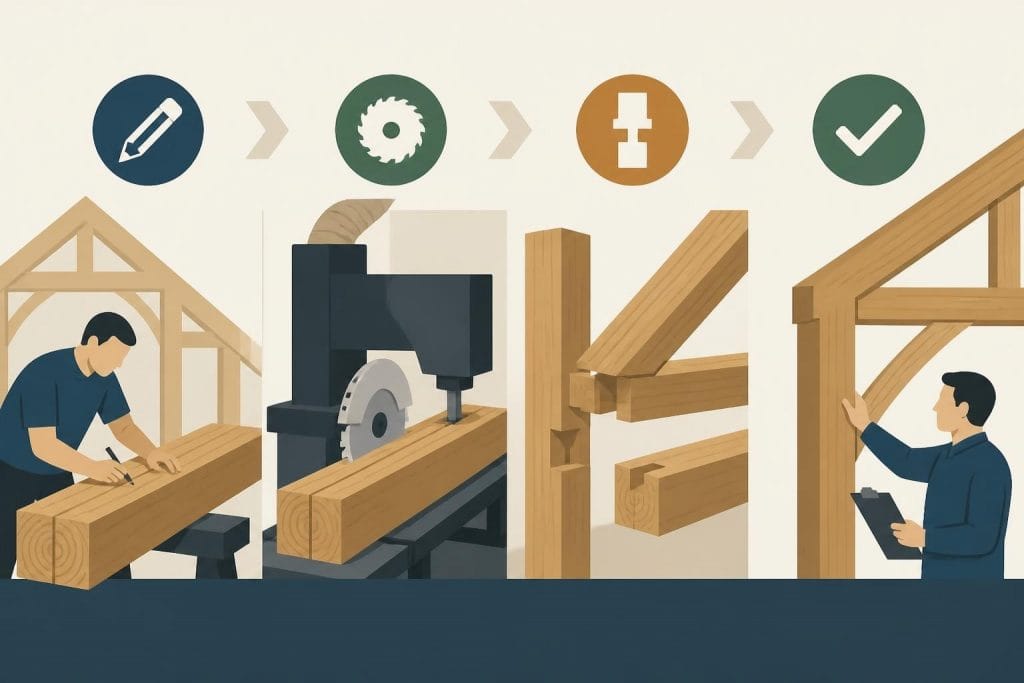
A timber workshop serves as the heart of any timber framing operation, where raw oak transforms into precisely crafted structural components that will stand for generations. Whether you're planning a bespoke timber frame garage, a traditional oak barn, or a complete house frame, the quality of workmanship begins long before assembly on site. Understanding the essential elements of a professional timber workshop provides valuable insight into the craftsmanship behind exceptional timber frame building construction details and helps property owners appreciate the skill involved in creating bespoke structures.
Setting Up a Professional Timber Workshop
Establishing a functional timber workshop requires careful planning and significant investment in both space and equipment. The workshop must accommodate large timber sections whilst providing safe working areas for precision cutting, joinery, and assembly.
Space and Layout Considerations
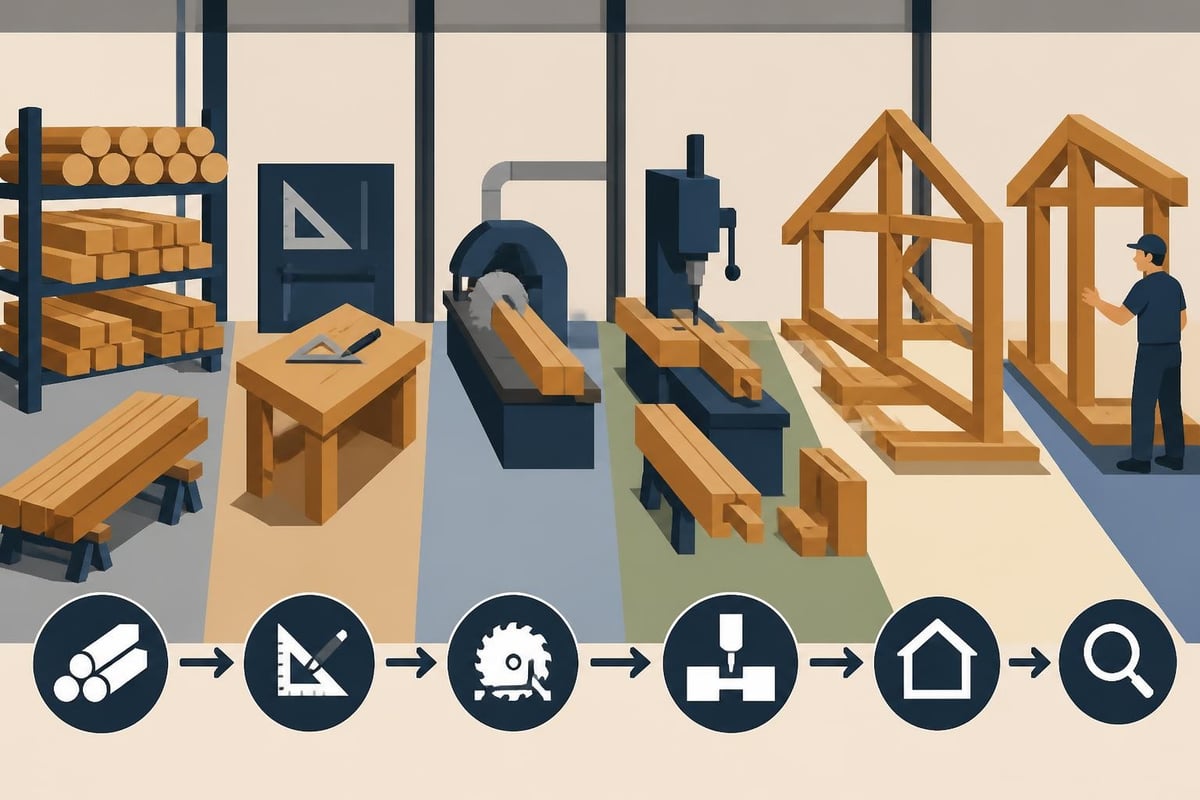
A well-designed timber workshop typically requires substantial floor space to handle full-length oak beams, which can measure 6 to 10 metres or more. The layout should facilitate a logical workflow from timber storage through cutting, joinery, and assembly stations. Adequate ceiling height proves essential, with most professional operations requiring minimum clearances of 5 metres to safely manoeuvre timber using overhead lifting equipment.
Key spatial requirements include:
- Dedicated storage areas for green oak and seasoned timber, separated by moisture content
- Machine placement allowing safe operator positioning and material handling
- Assembly space for trial-fitting frame sections before site delivery
- Finishing zones for planing, sanding, and quality inspection
- Vehicle access for timber deliveries and frame transportation
Temperature and humidity control significantly impacts timber quality. Whilst green oak frames are typically cut and assembled relatively fresh, a timber workshop benefits from controlled conditions that prevent excessive movement in the timber before joinery work completes.
Essential Machinery and Equipment
Professional timber frame production demands specialized machinery capable of handling substantial timber sections with precision. The investment in quality equipment directly impacts the accuracy of joints and the efficiency of production.
| Equipment Type | Primary Function | Key Features |
|---|---|---|
| Bandsaw | Deep cutting of large sections | Minimum 300mm throat depth, variable speed |
| Mortiser | Cutting mortise joints | Chain or chisel type, depth control |
| Tenoner | Forming tenon joints | Multiple cutter heads, adjustable dimensions |
| Planer/Thicknesser | Surface preparation | Wide bed for large timbers, dust extraction |
| Radial Arm Saw | Cross-cutting to length | Long bed support, precise angle adjustment |
Beyond fixed machinery, hand tools remain indispensable for fine adjustments and traditional joinery details. Chisels, mallets, marking gauges, and squares allow craftsmen to perfect joints and ensure the quality that defines superior timber structures. Modern workshops increasingly incorporate computer numerical control (CNC) equipment for complex cutting patterns whilst maintaining traditional methods for finishing work.
The Timber Framers Guild provides comprehensive guidance on safe work practices specific to timber framing operations, covering both machinery operation and hand tool techniques.
Safety Protocols in the Timber Workshop
Operating a timber workshop presents numerous hazards that require rigorous safety management. The combination of heavy materials, powerful machinery, and sharp tools demands constant vigilance and comprehensive safety protocols.
Personal Protective Equipment Requirements
Every person entering a timber workshop must wear appropriate protective equipment suited to the specific tasks and hazards present. Eye protection ranks as non-negotiable, with safety glasses or face shields protecting against flying wood chips, dust, and splinters. Hearing protection becomes essential when operating loud machinery, particularly bandsaws and planers operating for extended periods.
Steel-toed boots protect feet from dropped timber sections, whilst close-fitting work clothing prevents entanglement in rotating machinery. Dust masks or respirators filter fine wood particles, which present both immediate respiratory irritation and long-term health risks. The International Labour Organization outlines comprehensive safety and health practices for wood workshops, emphasizing the importance of proper protective equipment.
Machine Safety and Guarding
Modern woodworking machinery incorporates safety features, yet operator vigilance remains paramount. All rotating blades, cutter heads, and drive mechanisms must feature appropriate guarding that prevents accidental contact whilst allowing normal operation. Emergency stop buttons should be positioned within easy reach of every machine operator, clearly marked, and regularly tested for functionality.
Before operating any equipment, workers must receive thorough training on:
- Proper machine setup and adjustment procedures
- Correct timber positioning and handling techniques
- Emergency shutdown protocols
- Maintenance and inspection requirements
- Recognition of unsafe conditions or equipment malfunction
The OSHA woodworking eTool provides interactive guidance on machine guarding, dust control, and chemical safety relevant to timber workshop operations. Regular safety audits and refresher training ensure standards remain high and new hazards are promptly addressed.
Timber Selection and Preparation
The quality of finished timber frames begins with proper material selection and preparation within the timber workshop. Understanding wood characteristics and handling procedures ensures structural integrity and aesthetic appeal.
Working with Green Oak versus Seasoned Timber
Green oak, freshly felled with high moisture content, represents the traditional choice for timber framing. A timber workshop processing green oak must work relatively quickly, as the wood remains easier to cut and joint whilst still moist. The timber will subsequently shrink and settle over months and years, with joints designed to tighten rather than weaken during this process.
Seasoned timber, dried to lower moisture content, offers dimensional stability but requires greater cutting force and produces more dust. When working with various types of timber used in construction, workshop practices must adapt to the specific characteristics of each species and condition.
| Timber Condition | Moisture Content | Cutting Characteristics | Typical Applications |
|---|---|---|---|
| Green Oak | 40-60% | Easier cutting, less dust | Traditional frames, exposed structures |
| Air-Dried Oak | 15-20% | Moderate resistance | Indoor frames, furniture |
| Kiln-Dried Oak | 8-12% | Hard cutting, fine dust | Joinery, internal features |

Quality Inspection and Grading
Before cutting begins, experienced craftsmen inspect each timber section for defects that might compromise structural performance or appearance. Natural characteristics such as knots, shakes, and grain irregularities require careful evaluation. Small knots may be acceptable in non-critical areas, whilst splits near intended joints necessitate repositioning or rejection of the timber.
A professional timber workshop maintains strict quality standards, ensuring every component meets both structural requirements and aesthetic expectations. This attention to detail during material selection and preparation distinguishes superior craftsmanship from merely adequate work.
Joinery Techniques in Timber Frame Production
The timber workshop transforms selected oak into precisely fitted components through time-honoured joinery methods adapted with modern precision. Traditional joints provide both structural integrity and visual appeal that defines quality timber framing.
Traditional Joint Types and Their Applications
Mortise and tenon joints form the backbone of timber frame construction, with the tenon (projection) fitting precisely into the mortise (cavity) cut in the receiving timber. These joints, when properly executed, create connections that strengthen as the timber seasons and tightens. Variations include through-tenons, where the tenon passes completely through the mortise and is secured with oak pegs, and housed joints that conceal the connection.
Lap joints, where timbers overlap with material removed from each piece, suit applications requiring flush surfaces or decorative detailing. Scarf joints connect timbers end-to-end, essential when frame dimensions exceed available timber lengths. Each joint type serves specific structural and aesthetic purposes, selected based on loading conditions, timber orientation, and visual considerations.
Workshop efficiency increases when craftsmen specialize in particular joint types, developing the muscle memory and judgment that ensures consistent quality. The precision required for timber frame joinery far exceeds general carpentry standards, with tolerances measured in millimetres affecting joint performance over decades.
Cutting and Fitting Precision
Modern timber workshops employ both traditional layout methods and contemporary technology to achieve the precision timber framing demands. Marking out begins with full-scale drawings or computer-aided design files that specify exact dimensions and joint locations. Craftsmen transfer these measurements to the timber using scribes, squares, and marking gauges, creating clear cutting lines that guide subsequent machining.
During cutting operations, attention to grain direction, timber orientation, and blade selection determines the quality of finished surfaces and joint faces. Test fitting between mating components reveals any adjustments needed before final assembly. A skilled craftsman recognizes when joints require slight modifications, knowing that perfect paper dimensions don't always account for natural timber variations.
The workshop environment allows trial assembly of entire frame sections, ensuring proper fit before transportation to site. This pre-assembly stage identifies potential issues whilst correction remains straightforward, avoiding costly modifications during on-site erection.
Workshop Organisation and Workflow Efficiency
A well-organized timber workshop maximizes productivity whilst maintaining the quality standards essential for bespoke timber framing. Systematic approaches to material handling, component tracking, and workflow management separate professional operations from less sophisticated setups.
Material Handling Systems
Moving heavy oak timbers safely and efficiently requires appropriate equipment and procedures. Overhead gantry systems allow controlled lifting and positioning of long beams, whilst fork-lifts or telehandlers manage timber stock and completed components. Proper timber support during cutting operations prevents binding, kickback, and inaccurate cuts that compromise joint quality.
Storage systems must protect timber from weather damage whilst allowing easy access to required sections. Vertical racking suits long beams, horizontal stacking works for shorter pieces, and segregation by timber grade or project assignment prevents costly selection errors.
Project Management and Component Tracking
Complex timber frame projects involve hundreds of individual components, each cut to specific dimensions and fitted with particular joints. A timber workshop processing multiple concurrent projects requires robust tracking systems ensuring correct components reach their intended locations.
Modern approaches include:
- Component labeling matching workshop drawings and assembly instructions
- Digital project management tracking cutting schedules and completion status
- Quality checkpoints verifying dimensions and joint quality before progressing
- Assembly sequence planning ensuring components are produced in logical order
- Site coordination scheduling delivery to match on-site erection programmes
These organizational systems prove particularly valuable for bespoke timber frame projects where standard patterns don't apply and every component requires individual attention.
Environmental Considerations and Sustainability
Contemporary timber workshops increasingly address environmental impacts through dust control, waste management, and sustainable material sourcing. These practices protect worker health, comply with environmental regulations, and demonstrate responsible stewardship of natural resources.
Dust Extraction and Air Quality
Wood dust presents significant health hazards, with fine particles penetrating deep into lungs and causing both immediate irritation and long-term respiratory conditions. Professional timber workshops install comprehensive dust extraction systems capturing particles at source before they enter the workspace atmosphere. Fixed machinery connects to central extraction units with adequate capacity for the equipment served, whilst portable extractors support hand tool operations.
Regular filter maintenance and monitoring ensure extraction systems perform effectively. Air quality testing verifies that airborne particle concentrations remain within acceptable limits, protecting workers from cumulative exposure effects.
Waste Minimization and Reuse
Timber frame production generates substantial waste material through offcuts, shavings, and sawdust. Progressive timber workshops implement strategies to minimize waste and find productive uses for unavoidable byproducts. Careful cutting optimization maximizes usable components from each timber section, reducing material costs and environmental impact.
Larger offcuts may suit secondary products such as standard curved oak braces or firewood. Shavings and sawdust serve as animal bedding, garden mulch, or biomass fuel. Some operations compress wood waste into briquettes for heating, creating energy from material that might otherwise require disposal.
Advanced Workshop Capabilities
As timber framing techniques evolve and client expectations increase, leading timber workshops invest in advanced capabilities that expand design possibilities whilst maintaining traditional craftsmanship standards.
CNC Machining Integration
Computer numerical control (CNC) equipment brings precision and repeatability to complex cutting tasks. Multi-axis CNC routers execute intricate joinery patterns, decorative details, and compound angles with accuracy beyond manual methods. This technology particularly benefits projects requiring numerous identical components or complex geometric forms.
However, CNC integration complements rather than replaces skilled craftsmen. Programming requires deep understanding of timber behaviour, joinery principles, and structural requirements. Operators must verify automated cuts and make adjustments based on material variations that software cannot anticipate. The most successful timber workshops blend digital precision with traditional judgment.
Prefabrication and Modular Construction
Modern timber workshops increasingly adopt prefabrication approaches that maximize workshop production whilst minimizing on-site labour. Complete wall panels, roof sections, and structural modules arrive at site ready for rapid assembly, reducing weather exposure and site duration. Understanding how to build prefabricated workshop structures informs efficient production methods.
Prefabrication demands exceptional accuracy, as components must fit precisely without opportunity for on-site adjustment. Workshop quality control becomes even more critical, with dimensional verification at multiple stages ensuring compatibility between separately produced elements.
Maintaining a Men's Grooming Routine in the Workshop
Working in a timber workshop exposes skin and hair to sawdust, oils, and environmental stresses that demand proper care. Incorporating quality grooming products into your daily routine protects against occupational hazards whilst maintaining professional appearance. One Society offers all-natural men's grooming products specifically designed to look after skin, hair, and beard health despite challenging working conditions. Their natural formulations cleanse effectively without harsh chemicals that might exacerbate workshop-related skin irritation, helping craftsmen maintain both comfort and confidence throughout demanding workdays.
Quality Assurance and Standards Compliance
Professional timber workshops operate within frameworks ensuring structural adequacy and regulatory compliance. Quality assurance processes verify that finished components meet design specifications and relevant building standards.
Inspection Protocols
Systematic inspection occurs at multiple production stages, catching errors when correction remains straightforward. Initial timber grading ensures suitable material enters production. Post-cutting verification confirms dimensional accuracy and joint quality. Pre-assembly checks test component compatibility. Final inspection reviews completed frames against project specifications.
Documentation accompanies each project, recording timber sources, moisture content readings, joint specifications, and quality verifications. This traceability supports warranty claims and demonstrates compliance with building regulations.
Building Regulations and Structural Standards
Timber frames must satisfy UK Building Regulations covering structural adequacy, fire safety, and thermal performance. A timber workshop producing structural components works to engineering specifications developed by qualified designers who understand timber behaviour and loading conditions.
Compliance requires understanding relevant standards for timber grading, joint capacity, and structural calculation methods. Professional timber framers maintain current knowledge of regulatory requirements and industry best practices, ensuring workshop output meets all applicable standards.
Establishing and operating a professional timber workshop demands substantial investment, comprehensive safety management, and continuous skill development, yet these commitments yield the precision and quality that define exceptional timber frame structures. Whether you're planning a traditional oak garage, contemporary timber house, or bespoke garden structure, the craftsmanship begins in a well-equipped workshop where skilled hands transform raw oak into architectural elements of lasting beauty and structural integrity. Acorn to Oak Framing combines traditional workshop skills with modern precision to deliver bespoke timber frame buildings throughout the UK, bringing decades of experience to every project from initial design through final installation.


