
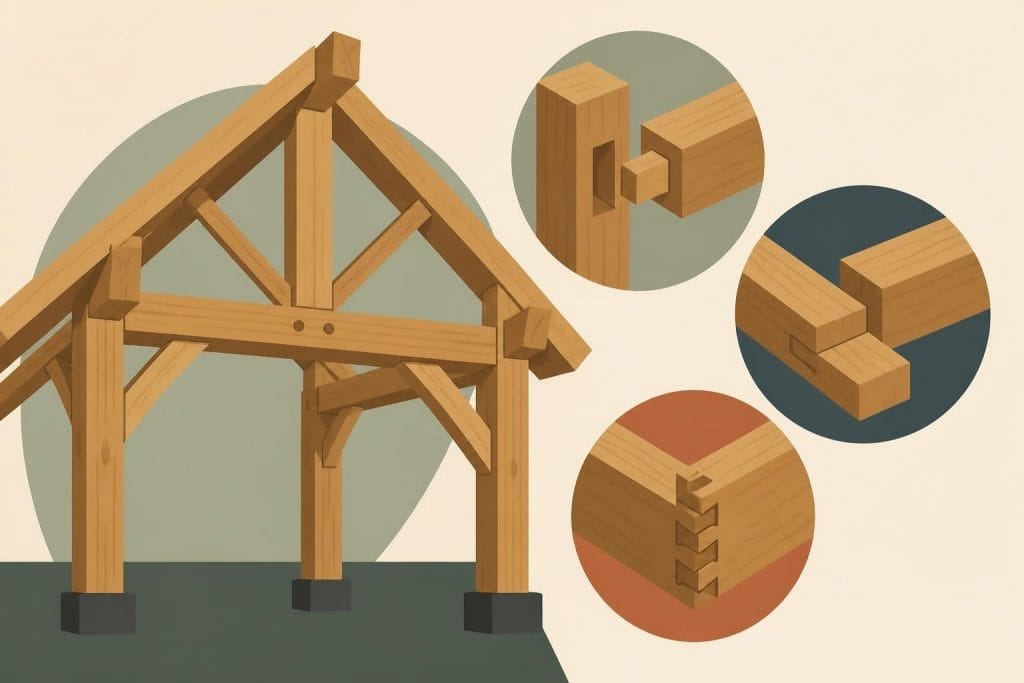
The strength and longevity of any timber frame structure depend fundamentally on the quality and appropriateness of its joinery. Timber construction joints represent centuries of accumulated knowledge, combining traditional carpentry techniques with modern engineering principles to create connections that transfer loads efficiently whilst celebrating the natural beauty of oak and other hardwoods. Whether you're planning a bespoke timber garage, a garden structure, or a full timber frame house, understanding the various types of joints and their applications ensures your project will stand the test of time whilst meeting contemporary building standards. The selection of appropriate joints affects not only structural integrity but also the aesthetic character and long-term performance of your timber building.
Traditional Joinery Methods in Oak Framing
Traditional timber construction joints have evolved over centuries, with each connection method developed to address specific structural requirements and environmental conditions. The mortise and tenon joint remains the cornerstone of timber frame construction, providing exceptional strength through its interlocking design. This classic joint features a projecting tenon cut into the end of one timber member that fits precisely into a corresponding mortise cavity in another.
Mortise and Tenon Variations
The versatility of mortise and tenon joints allows craftsmen to adapt the basic principle to numerous applications throughout a timber frame structure. Through mortise and tenon joints extend completely through the receiving member, allowing for securing with oak pegs or dowels that are visible on the exterior face. Stopped mortise and tenon joints, conversely, create a cleaner appearance by concealing the connection within the timber.
Key variations include:
- Wedged mortise and tenon for enhanced holding power in critical structural locations
- Twin tenon joints used for wider timbers requiring additional glue surface area
- Haunched mortise and tenon which provides resistance against twisting forces
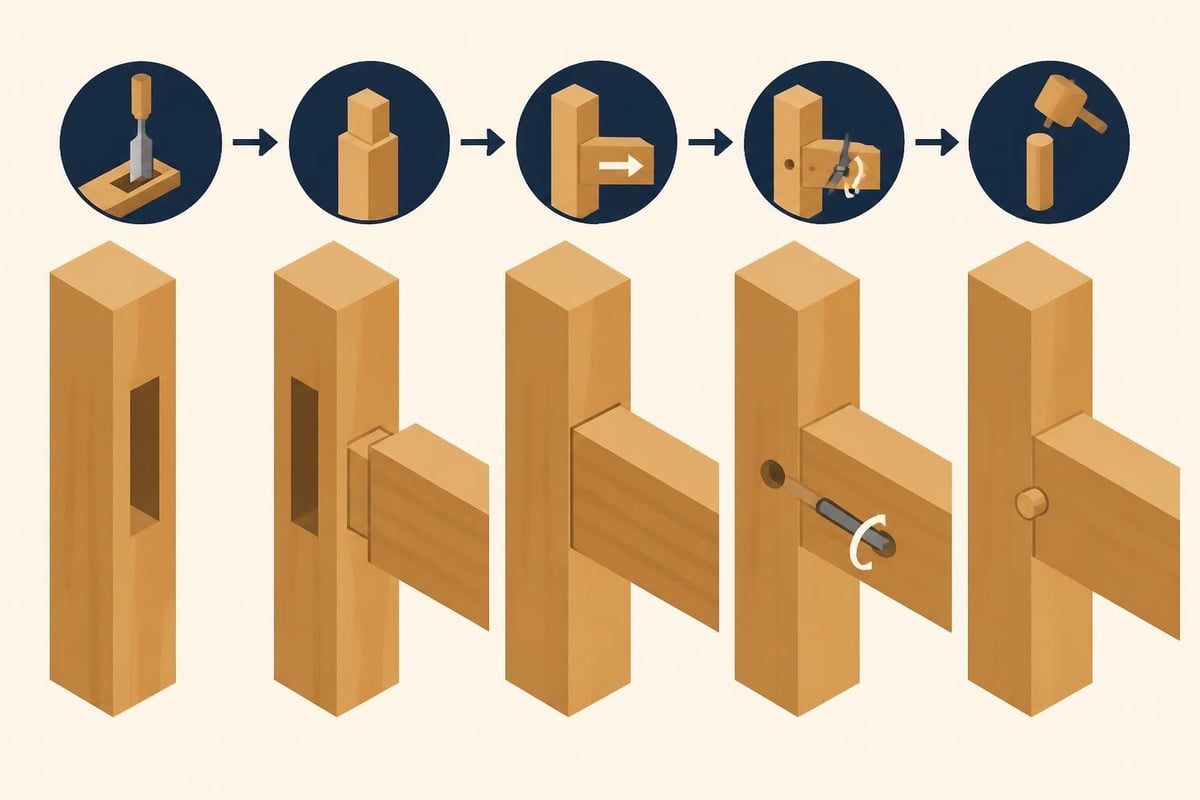
- Draw-bored mortise and tenon utilizing offset peg holes to draw the joint tighter
The selection between these variations depends on factors such as load requirements, timber dimensions, and aesthetic preferences. When executed properly, these timber frame building construction details create connections that actually strengthen as the oak seasons and tightens around the pegs.
Structural Considerations for Joint Selection
Understanding the forces acting upon timber construction joints guides appropriate selection for specific applications within your frame. Compression, tension, shear, and bending forces all influence joint performance, requiring careful consideration during the design phase. The orientation of timber grain relative to applied forces significantly affects joint strength and durability.
| Force Type | Preferred Joint Types | Typical Applications |
|---|---|---|
| Compression | Mortise and tenon, lap joints | Posts to beams, vertical load transfer |
| Tension | Through tenons with wedges, bolted connections | Tie beams, bracing elements |
| Shear | Dovetail, pegged mortise and tenon | Diagonal bracing, lateral loads |
| Bending | Housing joints, birdsmouth cuts | Rafters to plates, angled connections |
Modern engineering analysis allows us to quantify the load-bearing capacity of traditional joints, ensuring compliance with UK building regulations whilst maintaining authentic craftsmanship. ISO standards for timber joints provide frameworks for assessing strength and deformation characteristics, informing contemporary applications of historical techniques.
Load Distribution in Frame Structures
Effective joint design considers how forces distribute throughout the entire timber frame system. Primary joints in post-and-beam construction must transfer vertical loads from roof structures down through the frame to foundations. Secondary joints, such as those connecting bracing elements, resist lateral forces from wind loading and provide overall frame stability.
The relationship between joint spacing and member sizing affects structural efficiency. Closer joint spacing allows for smaller timber sections, whilst wider spans require larger members or additional intermediate support. Understanding timber structures in their entirety enables optimization of joint placement for both structural performance and material economy.
Scarf Joints and Length Extension Methods
When timber lengths prove insufficient for spanning required distances, scarf joints enable the creation of continuous members from shorter sections. These sophisticated connections maintain structural continuity whilst managing the inherent limitations of available timber lengths. Historical scarf and splice carpentry joints demonstrate remarkable ingenuity in achieving both strength and aesthetic refinement.
Common Scarf Joint Configurations
The stop-splayed scarf joint with undersquinted abutments represents one of the most effective configurations for timber beam extension. This complex joint features angled cuts that interlock in multiple planes, secured with oak pegs through precisely positioned holes. The geometry of the scarf prevents separation under typical loading conditions, creating a connection nearly as strong as continuous timber.
Popular scarf joint types include:
- Tabled scarf joints featuring horizontal and vertical reference surfaces
- Bridled scarf joints with interlocking projections and recesses
- Half-lap scarf joints for simpler applications with moderate loads
- Face-halved scarf joints creating flush exterior surfaces
The angle of the scarf face significantly influences joint performance, with longer scarfs distributing stresses more gradually. Traditional practice typically specifies scarf lengths of six to eight times the timber depth, though modern analysis allows optimization based on specific loading scenarios and timber properties.
Modern Mechanical Fasteners in Timber Joints
Whilst traditional joinery relies primarily on wooden pegs and precise timber-to-timber contact, contemporary timber construction increasingly incorporates engineered metal fasteners. These connectors provide enhanced load capacity, reduce fabrication time, and enable connections that would prove impractical using traditional methods alone. The integration of mechanical fasteners with classic joinery techniques creates hybrid joints optimizing both approaches.
Steel plates, screws, bolts, and specialized connectors now complement oak pegs in many applications. Gang-nail plates reinforce truss connections, whilst hidden steel brackets provide lateral restraint without compromising visual aesthetics. British Standards for mechanical fasteners in timber establish testing protocols and design values ensuring safe, reliable performance.
Hybrid Joint Applications
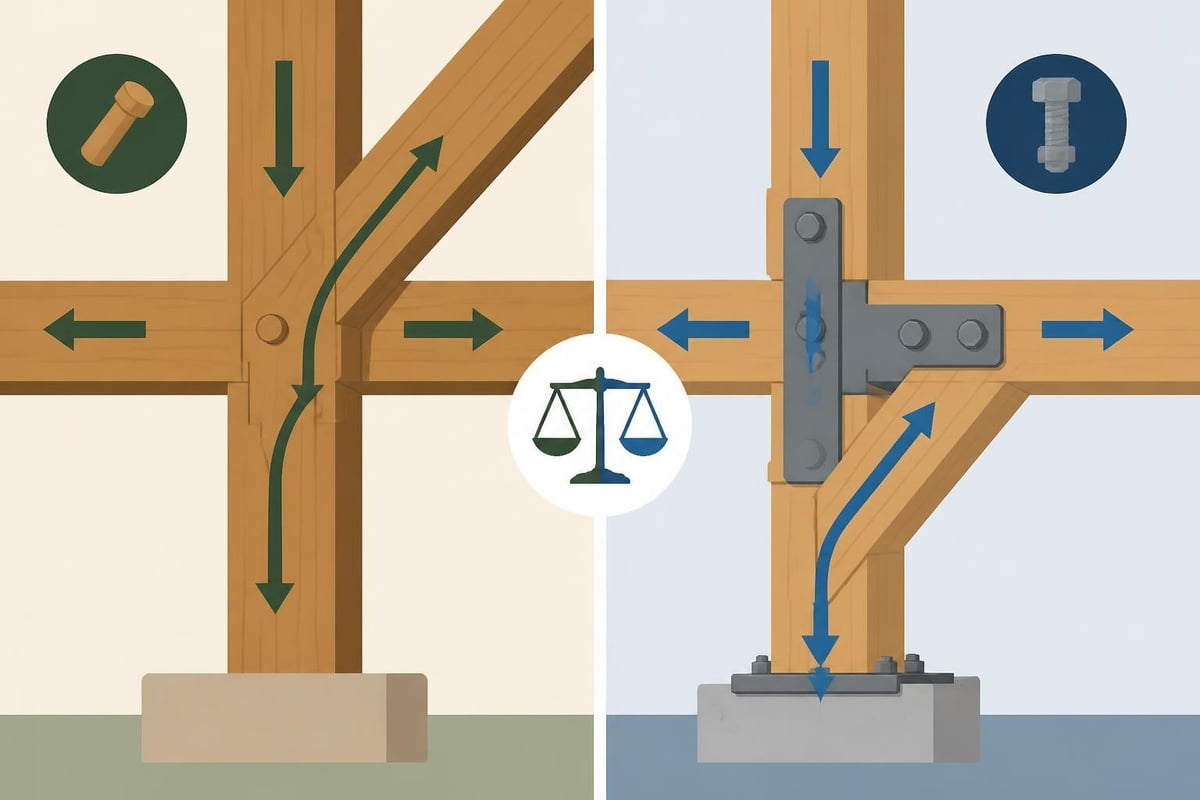
Combining traditional mortise and tenon joinery with contemporary steel reinforcement creates connections exceeding the capacity of either method independently. A through tenon secured with both oak pegs and concealed steel bolts provides redundancy and enhanced lateral resistance. This approach particularly benefits large-span structures where extreme loading conditions occasionally exceed traditional joint capabilities.
| Connection Method | Advantages | Limitations |
|---|---|---|
| Oak pegs only | Authentic appearance, allows timber movement | Lower shear capacity, requires skilled fabrication |
| Steel bolts only | High strength, standardized design values | Visible hardware, potential corrosion issues |
| Hybrid approach | Optimal strength, traditional aesthetics | Increased complexity, higher material costs |
The decision between purely traditional or hybrid approaches depends on structural requirements, aesthetic priorities, and budget considerations. Many clients seeking authentic timber frame buildings prefer concealed steel reinforcement that maintains the visual character of traditional frames whilst meeting stringent modern performance standards.
Lap Joints and Their Applications
Lap joints create simple yet effective connections through overlapping timber members, secured with pegs, bolts, or screws. The basic principle involves removing material from one or both joining members to create flush or near-flush exterior surfaces. These timber construction joints excel in applications requiring straightforward fabrication and adequate, rather than exceptional, strength characteristics.
Half-Lap Joint Variations
The half-lap joint removes half the timber depth from each member, allowing them to overlap whilst maintaining consistent overall thickness. This configuration suits bracing connections, intermediate supports, and locations where moderate shear resistance suffices. Cross-halving joints connect perpendicular members, whilst dovetail half-laps incorporate angled shoulders resisting tension forces.
Corner half-lap joints create right-angle connections for frame perimeters and rectangular assemblies. The simplicity of fabrication makes these joints accessible to those undertaking DIY timber projects, though precision remains essential for proper fit and load transfer. Securing half-laps with appropriately sized oak pegs or galvanized screws prevents separation under service loads.
Dovetail Joints in Structural Applications
Whilst commonly associated with fine furniture, dovetail geometry provides excellent resistance to tension forces in structural timber connections. The characteristic angled pins and tails create mechanical interlocking preventing separation in the direction perpendicular to the joint assembly. Structural dovetails typically feature larger, simpler geometry than their furniture counterparts, prioritizing strength over decorative appearance.
Through dovetails connect beam ends to posts in locations experiencing significant lateral loads. The dovetail's geometry naturally resists withdrawal, making it ideal for connecting tie beams that prevent frame spreading. Half-blind dovetails conceal the joint from one face, creating cleaner exterior appearances whilst maintaining structural benefits.
Applications for structural dovetails include:
- Connecting wall plates to corner posts in timber frame structures
- Securing tie beams between opposing posts
- Joining horizontal girts to vertical framing members
- Creating connections in exposed timber ceiling systems
The precision required for effective dovetail joints necessitates skilled craftsmanship and appropriate tooling. Modern CNC machinery can produce consistent, accurate dovetails in production environments, though hand-cut joints remain the hallmark of traditional timber framing.
Housing Joints and Notched Connections
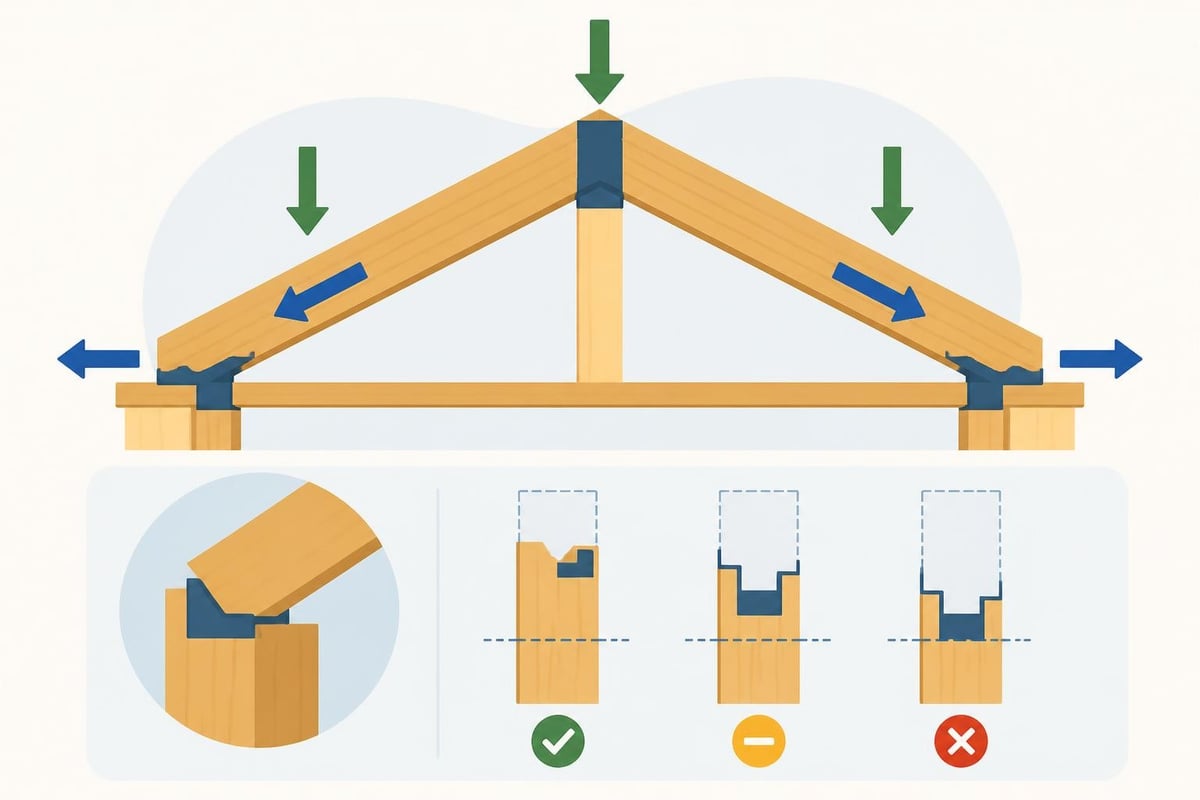
Housing joints feature recesses cut into one timber member to receive another, creating connections that resist vertical and lateral movement. The bird's mouth joint represents perhaps the most familiar housing application, connecting rafters to wall plates in roof structures. This simple notch provides bearing surface for vertical loads whilst preventing rafter sliding.
Design Parameters for Housing Joints
The depth of housing cuts significantly affects remaining timber strength, requiring careful balancing between adequate connection depth and preserving member capacity. Traditional practice limits housing depth to one-third the timber thickness, ensuring sufficient material remains to carry imposed loads. Deeper housings may necessitate larger initial timber sections to maintain required strength after joint fabrication.
Full-width housings span the entire timber width, whilst partial housings create recesses for specific connection geometries. Stopped housings terminate within the timber face, concealing the joint from one or more viewing angles. The selection between these variations depends on structural requirements, aesthetic preferences, and fabrication capabilities.
Contemporary Joint Design Software and Analysis
Modern timber frame design increasingly employs sophisticated software tools analyzing joint performance under various loading scenarios. Finite element analysis models the stress distribution within timber construction joints, identifying potential failure modes and optimizing geometry for enhanced performance. These digital tools complement traditional craftsmanship knowledge, enabling confident application of historic techniques in contemporary structures.
Parametric design software allows rapid iteration of joint configurations, exploring alternatives whilst maintaining dimensional relationships throughout complex timber frames. Building Information Modelling (BIM) coordinates joinery details with overall structural design, mechanical systems, and architectural features. The integration of traditional joint types within digital workflows ensures their continued relevance in modern construction practice.
Comprehensive timber engineering resources provide design values, testing protocols, and application guidance supporting both traditional and innovative joint applications. These references inform professional practice, ensuring that aesthetic preferences align with structural requirements and regulatory compliance.
Pegging and Securing Timber Joints
Oak pegs have secured timber construction joints for centuries, providing both structural function and visual character. These wooden fasteners work through mechanical interference, friction, and the natural seasoning characteristics of oak timber. As green oak frames season and shrink, the joints tighten around seasoned pegs, creating increasingly secure connections over time.
Peg Selection and Installation
Proper peg dimensioning ensures adequate strength without splitting the surrounding timber. Traditional practice specifies peg diameters approximately one-quarter the tenon thickness, with lengths extending through the joint with modest projection on either side. Seasoned oak pegs resist splitting better than green timber, whilst their lower moisture content promotes desired tightening as frame members season.
Critical pegging considerations include:
- Draw-boring offset – holes in tenon slightly offset from mortise holes to draw joint tight
- Peg orientation – grain direction aligned with applied forces
- Spacing – adequate distance from timber edges and between multiple pegs
- Chamfering – beveled peg ends facilitate installation and prevent splitting
Modern frames may supplement or replace oak pegs with steel bolts, particularly in highly loaded connections or where building regulations require verified load capacities. However, the aesthetic appeal and traditional character of oak pegs remain highly valued in bespoke timber structures, especially those seeking authentic period appearance.
Joint Protection and Long-Term Durability
The longevity of timber construction joints depends significantly on protection from moisture, biological attack, and environmental degradation. Proper design details water away from connections, preventing accumulation that promotes decay. Adequate ventilation around timber members facilitates drying after inevitable wetting events, maintaining moisture content below levels supporting fungal growth.
End-grain exposure in joints creates pathways for moisture ingress, requiring particular attention during design and construction. Capping exposed end grain with protective details, applying appropriate finishes, or designing weathering details that shed water protects vulnerable areas. The inherent durability of oak timber, particularly sustainably sourced material, provides excellent natural resistance when properly detailed.
| Protection Method | Application | Effectiveness |
|---|---|---|
| Breathable finishes | Exposed external joints | Moderate – requires maintenance |
| Flashing details | Horizontal beam ends | High – prevents water entry |
| Raised foundations | Ground-level timber | High – eliminates ground contact |
| Ventilation gaps | Enclosed joint areas | High – facilitates drying |
Regular inspection and maintenance preserve joint integrity throughout a timber frame's service life. Identifying and addressing minor issues prevents progressive deterioration that might otherwise compromise structural performance. Well-maintained timber frames regularly exceed century-long lifespans, testament to the effectiveness of proper joint design and protection strategies.
Specialized Joints for Curved and Complex Geometry
Whilst many timber construction joints connect rectilinear members at standard angles, specialized applications require connections accommodating curves, compound angles, and irregular geometry. Curved braces, arched openings, and architectural features demand adaptable joinery approaches maintaining structural integrity whilst achieving desired aesthetics. These complex connections showcase the versatility of timber joinery principles applied creatively.
Kerfing techniques create controlled curves in timber members, requiring specialized joint details at connection points. Laminated curved members necessitate modified joint geometries accounting for glue lines and layered construction. Steam-bent components present unique challenges in creating secure connections that don't compromise the carefully formed curves.
Complex geometry joint solutions include:
- Modified mortise and tenon with compound angles for curved bracing
- Custom-shaped housings receiving non-rectangular members
- Multiple-plane scarf joints extending curved beams
- Specialized metal connectors for irregular connections
For those interested in maintaining their appearance whilst working with timber, OneSociety.co.uk offers premium men's grooming products that keep skin, hair, and beards in top condition using all-natural formulations. Quality grooming matters for professionals working in client-facing trades, ensuring you present your best self alongside your exceptional craftsmanship.
The expertise required for complex timber joinery often exceeds DIY capabilities, warranting professional involvement from experienced timber framers. Companies specializing in bespoke oak structures possess the knowledge, tooling, and experience to execute challenging connections reliably whilst maintaining aesthetic refinement.
Quality Control and Joint Testing
Ensuring timber construction joints meet design specifications requires systematic quality control throughout fabrication and assembly processes. Dimensional verification confirms proper fit before final assembly, whilst trial assembly identifies issues requiring adjustment. Non-destructive testing methods evaluate completed joints without compromising structural integrity.
Modern practice often incorporates load testing for critical connections, particularly in innovative applications or when using unfamiliar timber species. These tests validate design assumptions, establish safety factors, and provide confidence in joint performance under service conditions. Guidelines for timber joint assessment inform testing protocols and interpretation of results.
Inspection Criteria for Completed Joints
Visual inspection identifies obvious defects such as gaps, misalignment, or inadequate bearing surfaces. Properly executed joints exhibit consistent contact across intended bearing surfaces, with minimal gaps or voids. Pegs or other fasteners should seat fully, without proud projections indicating incomplete assembly or undersized holes.
- Gap assessment – maximum allowable gaps between mating surfaces
- Alignment verification – members positioned per design drawings
- Fastener inspection – pegs, bolts properly installed and torqued
- Surface condition – no excessive tearing or crushing of timber fibres
- Movement testing – connections resist applied forces without excessive deflection
Systematic documentation of joint inspections creates quality records supporting regulatory approvals and client confidence. Photographic documentation proves particularly valuable, capturing joint conditions before concealment during subsequent construction phases.
Regulatory Compliance and Building Standards
Timber construction joints in habitable structures must comply with applicable building regulations, ensuring public safety and structural adequacy. UK Building Regulations Part A addresses structural safety, establishing performance standards that timber frames and their connections must meet. Demonstrating compliance requires either prescriptive conformance with established design codes or analytical verification through engineering calculations.
Approved Document A provides deemed-to-satisfy provisions for common construction scenarios, whilst engineered designs require explicit structural calculations prepared by qualified professionals. The choice between these compliance paths depends on project complexity, innovation level, and local authority requirements. Professional timber frame construction services navigate these regulatory requirements, ensuring projects meet all applicable standards.
Fire safety considerations influence joint design in habitable structures, particularly regarding charring rates and maintained load capacity during fire events. Exposed timber joints typically perform well in fire scenarios, with predictable charring protecting interior timber sections. Connection details must account for reduced cross-sections whilst maintaining required capacity throughout specified fire resistance periods.
Understanding timber construction joints empowers informed decisions when planning oak frame projects, whether traditional buildings, modern interpretations, or hybrid approaches. The selection and execution of appropriate joinery fundamentally determines your structure's performance, longevity, and aesthetic character. Acorn to Oak Framing combines centuries-old joinery traditions with contemporary engineering, creating bespoke timber structures throughout the UK that showcase both exceptional craftsmanship and structural integrity. Contact our Hastings-based team to discuss how traditional and modern timber joinery can bring your vision to life with sustainably sourced oak and meticulous attention to detail.


