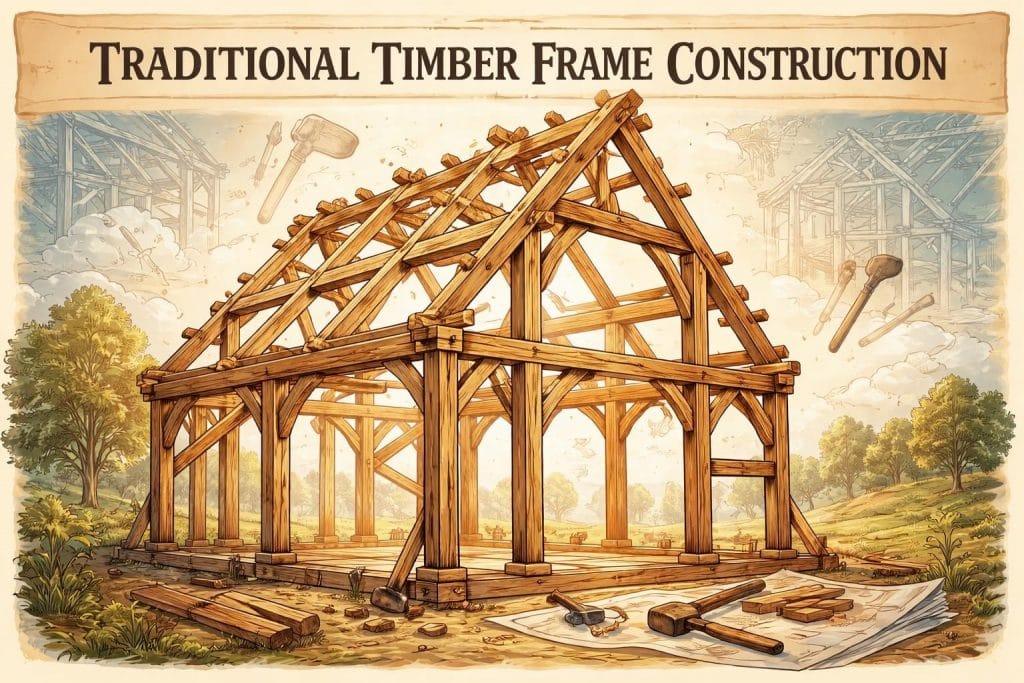
Framed houses represent one of the most enduring and versatile construction methods in British architecture, combining centuries-old craftsmanship with contemporary building science. From traditional timber framing techniques that date back to medieval times to modern platform framing systems, these structures offer exceptional durability, design flexibility, and environmental benefits. Understanding the various approaches to constructing framed houses empowers homeowners, developers, and renovators to make informed decisions about their building projects, whether they're creating a new-build home, extending an existing property, or restoring a heritage structure.
Understanding Traditional Framing Methods
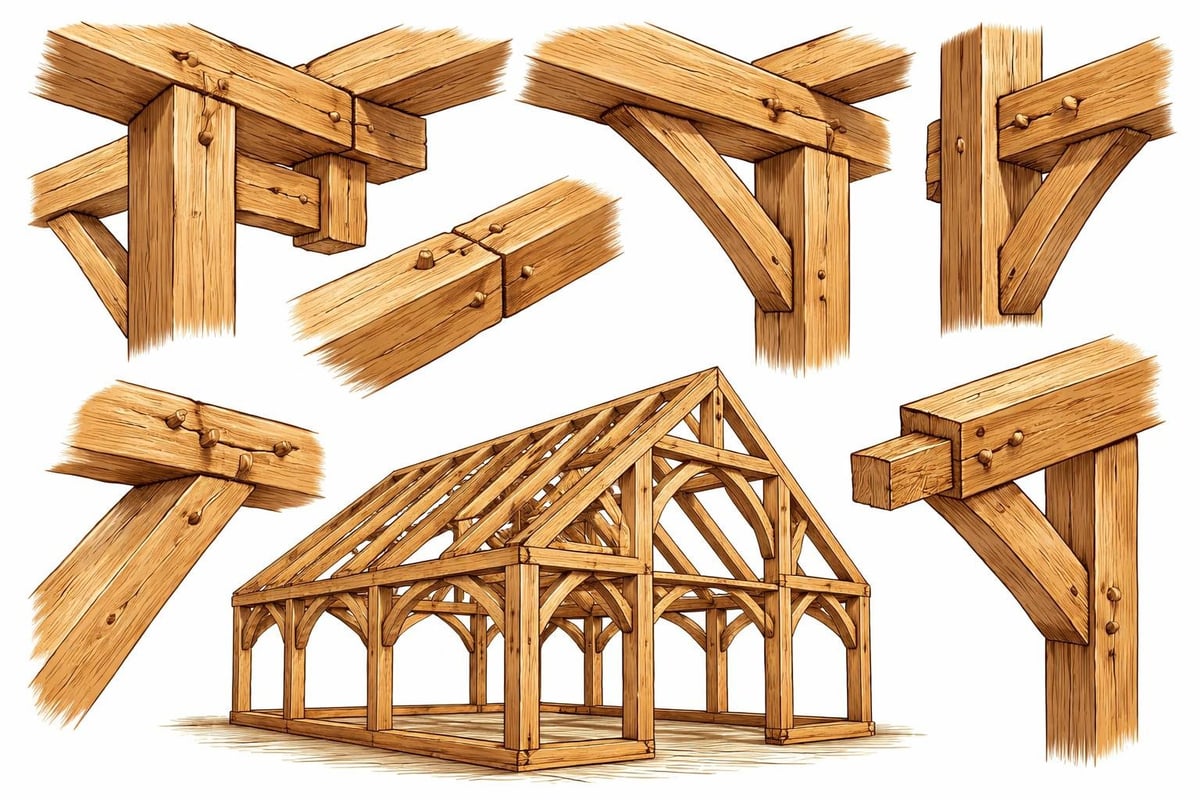
The foundation of framed houses lies in their structural skeleton, which supports the entire building. Timber framing has been the predominant method in Britain for centuries, using heavy timber posts and beams joined together through mortise-and-tenon joinery. This approach creates a robust framework that carries all structural loads independently of the wall infill.
Traditional oak frame construction exemplifies this method beautifully. The timber skeleton consists of principal posts positioned at regular intervals, connected by horizontal beams and diagonal braces that provide stability against lateral forces. Unlike modern stud framing where numerous smaller members carry the load, traditional framing concentrates structural strength in fewer, larger timbers.
Historical Evolution of House Framing
Key developments in framing technology include:
- Medieval cruck framing using curved timbers
- Box-frame construction with vertical posts and horizontal rails
- Post-and-beam systems featuring exposed structural elements
- Modern platform framing with dimensional lumber
- Contemporary hybrid approaches combining traditional and modern methods
The Wisconsin Historical Society documents how framing methods evolved throughout history, with each innovation responding to available materials, climate conditions, and building requirements. British timber framing developed its distinctive characteristics based on abundant oak resources and the need for durable structures in the country's maritime climate.
Modern Platform Framing Techniques
Contemporary framed houses often employ platform framing, also known as stick-built construction. This method constructs each storey as a separate platform, with wall frames erected on the floor deck before the next level begins. The systematic approach allows for efficient construction whilst maintaining structural integrity.
Platform framing uses dimensional lumber, typically 38mm by 89mm or 38mm by 140mm sections, positioned at regular centres. These studs create vertical load paths whilst also forming cavities for insulation and services. The repetitive nature of this construction method makes it cost-effective and accessible to a wide range of builders.
| Framing Component | Function | Typical Spacing |
|---|---|---|
| Wall studs | Vertical support | 400mm or 600mm centres |
| Floor joists | Horizontal floor support | 400mm or 600mm centres |
| Roof rafters | Pitched roof structure | 400mm or 600mm centres |
| Header beams | Span openings | As required by load |
Modern contemporary timber frame houses often incorporate both traditional aesthetic elements and modern construction efficiency. This hybrid approach delivers the visual warmth of exposed timber whilst meeting current building regulations for thermal performance and structural safety.
Advanced Framing for Energy Efficiency
Advanced house framing techniques optimize material usage whilst enhancing thermal performance. These methods reduce thermal bridging, where heat escapes through structural members, and increase the amount of insulation within wall assemblies. For those building framed houses in 2026, these approaches offer significant long-term operational savings.
The principles of advanced framing include aligning framing members vertically throughout the structure, using insulated headers over openings, and employing two-stud corners instead of traditional three-stud assemblies. Each modification reduces lumber whilst improving the building's thermal envelope.
Key Advanced Framing Strategies
Thermal performance improvements:
- Single top plates with aligned studs reduce lumber and thermal bridging
- Ladder blocking at exterior wall intersections maximizes insulation space
- Insulated headers sized appropriately for actual loads rather than arbitrary rules
- Staggered stud walls or double-wall systems for exceptional insulation depths
- Optimized stud spacing at 600mm centres where structural loads permit
Meadowlark Builders explains how these techniques can reduce lumber usage by up to 30% whilst improving thermal performance by 20% or more. For UK builders working with timber used in construction, these methods align sustainability with building performance.
Structural Considerations for Framed Houses
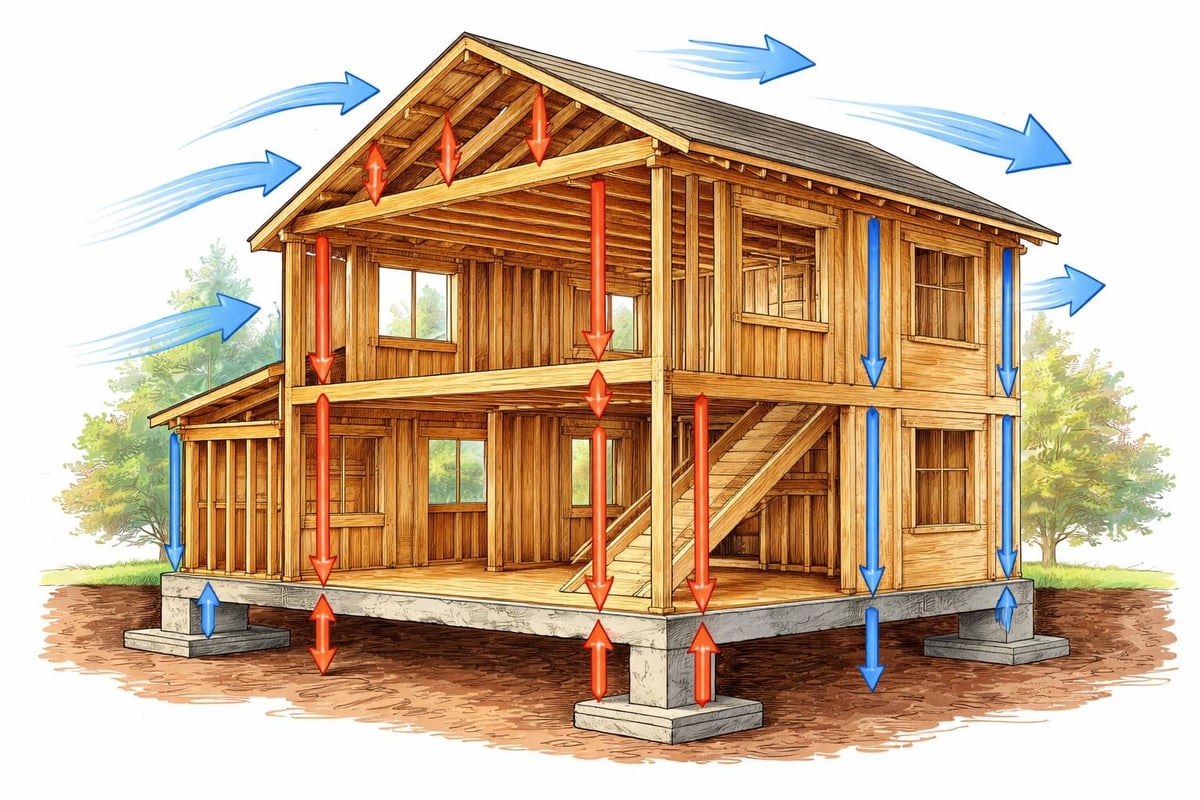
Designing framed houses requires careful attention to load paths, lateral stability, and material properties. The structural frame must transfer all loads-dead loads from the building's own weight, live loads from occupancy, and lateral loads from wind-safely to the foundations.
Framing in construction encompasses various systems, each with specific structural characteristics. Traditional timber frames rely on triangulated bracing and rigid joints, whilst modern platform frames use sheathing panels to provide racking resistance. Understanding these principles ensures safe, durable construction.
Critical Structural Elements
The structural integrity of framed houses depends on proper connection detailing. Metal brackets, bolts, and traditional wooden pegs each serve specific purposes in transferring forces between members. Modern building codes specify minimum connection requirements, but traditional methods often exceed these standards through time-proven joinery.
Essential connection points include:
- Sill plate to foundation anchorage
- Stud to plate connections at top and bottom
- Rafter or truss connections to wall plates
- Shear wall hold-downs at high-stress locations
- Beam to post connections in post-and-beam frames
When constructing a timber frame hybrid house, integrating different framing systems requires particular attention to compatibility and load transfer. Hybrid designs might combine structural timber frames with insulated panels or conventional stud infill, offering both aesthetic and performance benefits.
Insulation and Thermal Performance
Insulating timber frame walls effectively determines the long-term comfort and running costs of framed houses. The cavity between studs provides natural space for insulation, but achieving optimal thermal performance requires attention to detail at junctions, openings, and service penetrations.
Modern insulation materials for framed houses include mineral wool, wood fibre boards, sheep's wool, and closed-cell foam products. Each offers different thermal properties, vapour permeability, and environmental credentials. Selecting appropriate materials depends on the specific wall build-up, local climate, and sustainability objectives.
| Insulation Type | Thermal Conductivity | Vapour Permeability | Sustainability Rating |
|---|---|---|---|
| Mineral wool | 0.035-0.040 W/mK | High | Good |
| Wood fibre | 0.038-0.040 W/mK | Medium-High | Excellent |
| Sheep's wool | 0.035-0.038 W/mK | High | Excellent |
| PIR foam board | 0.022-0.025 W/mK | Very Low | Moderate |
Achieving airtightness in framed houses presents specific challenges due to numerous connections and penetrations. Continuous air barriers, careful taping of joints, and proper service integration prevent unwanted air leakage that degrades thermal performance and can cause condensation issues within the structure.
Design Flexibility and Architectural Expression
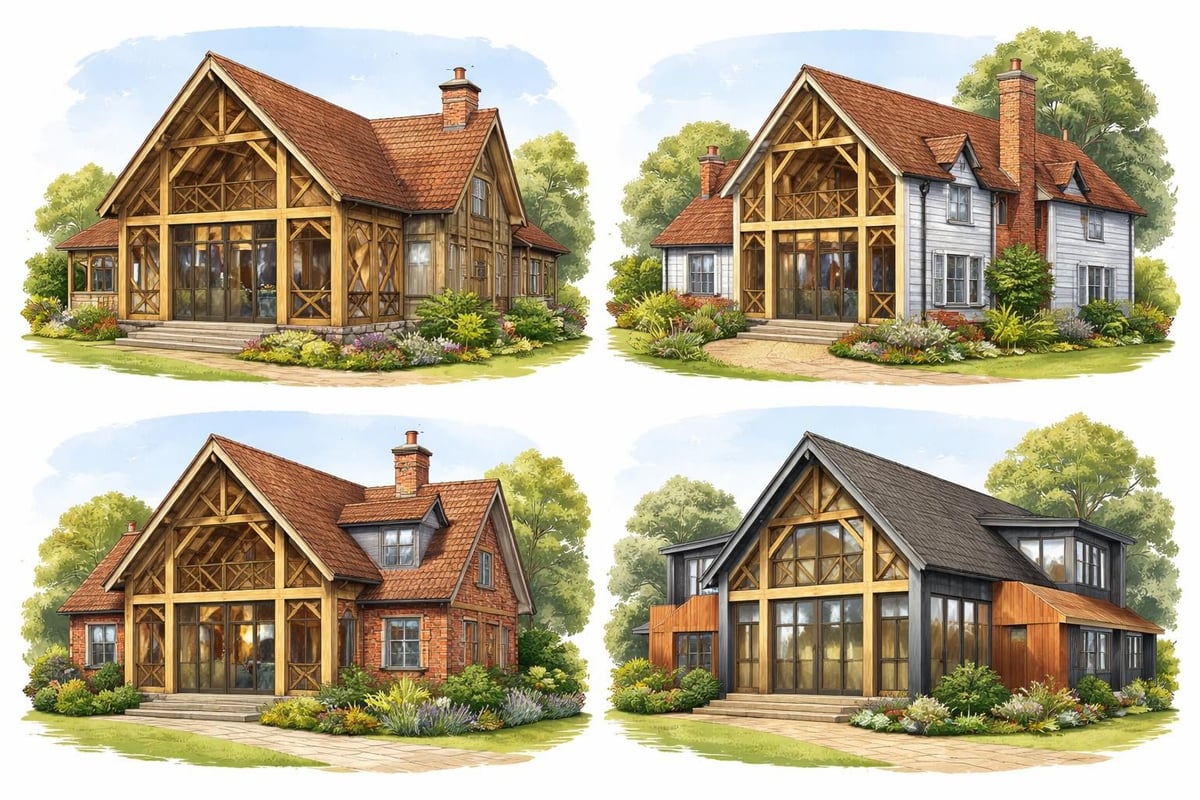
One significant advantage of framed houses lies in their architectural versatility. The structural frame can be concealed behind cladding for contemporary aesthetics or exposed to celebrate traditional craftsmanship. This flexibility allows designers to create everything from modern minimalist dwellings to heritage-inspired homes.
Exposed timber framing showcases the beauty of natural materials whilst making structural elements part of the interior design. Oak framed homes particularly exemplify this approach, where substantial oak posts and beams create dramatic interior spaces with character that improves over time.
Cladding Options for Framed Construction
External finishes compatible with framed houses:
- Traditional oak weatherboarding
- Render on insulated panels or lath
- Brick slips or full brick cladding
- Vertical timber boarding
- Composite panels with modern detailing
- Stone or slate hanging
- Metal cladding systems
The separation between structure and cladding in framed houses means exterior finishes can be modified or updated without affecting structural integrity. This modularity extends the building's lifespan and adaptability to changing aesthetic preferences or performance requirements.
Cost Considerations and Project Planning
Understanding frame house cost involves more than comparing material prices. The total project budget encompasses design fees, groundworks, the frame itself, insulation and cladding, services, and finishes. Timber framing often represents 15-25% of the total build cost, with significant variation based on complexity and specification.
Traditional oak framing typically commands premium pricing due to material costs and specialist craftsmanship required. However, this investment delivers exceptional durability, minimal maintenance, and timeless aesthetic appeal. Modern platform framing offers more economical construction whilst still providing excellent performance when properly designed and built.
Budget planning factors:
- Foundation requirements based on ground conditions
- Frame complexity and material specifications
- Insulation standards and thermal performance targets
- External cladding choices and detailing
- Internal finishes and service integration
- Professional fees for design and certification
Working with experienced specialists ensures realistic budget expectations and avoids costly errors. Frame homes benefit from early engagement with timber frame specialists who can advise on design optimization, material selection, and construction sequencing.
Building Regulations and Standards Compliance
All framed houses in the UK must comply with Building Regulations covering structural safety, fire resistance, thermal performance, and accessibility. These standards have evolved significantly, with current requirements demanding high levels of energy efficiency and environmental performance.
Structural calculations verify that the frame can safely carry anticipated loads with appropriate safety factors. For timber frame home UK projects, engineers consider timber strength grades, connection capacities, and deflection limits to ensure robust, compliant designs.
| Regulation Part | Requirement Area | Key Considerations for Framed Houses |
|---|---|---|
| Part A | Structure | Load calculations, connection design, foundation adequacy |
| Part B | Fire safety | Compartmentation, escape routes, material specifications |
| Part C | Site preparation | Damp-proofing, ground conditions, radon protection |
| Part L | Conservation of fuel and power | U-values, airtightness, thermal bridging mitigation |
Fire resistance requirements influence frame detailing, particularly at junctions and around openings. Timber frames achieve required fire ratings through appropriate sizing of members, protective cladding, and compartmentation strategies. Modern engineered solutions provide certified fire performance whilst maintaining design flexibility.
Sustainability and Environmental Impact
Timber-framed houses offer compelling environmental credentials when constructed with responsibly sourced materials. Wood stores carbon throughout the building's life, offsetting emissions from other construction activities. Sustainably managed forests provide a renewable resource that supports biodiversity and rural economies.
Wooden construction typically has lower embodied energy than concrete or steel alternatives. This advantage increases when considering the full lifecycle, including eventual deconstruction and material reuse. Well-maintained timber frames can last centuries, with many medieval examples still in use today.
Environmental benefits of timber framing:
- Carbon sequestration in structural timber
- Lower embodied energy compared to masonry or steel
- Renewable material from sustainable forestry
- Recyclability and biodegradability at end of life
- Reduced construction waste through precision manufacturing
- Excellent thermal performance reducing operational energy
Specifying locally sourced timber further reduces transportation emissions whilst supporting regional economies. British-grown oak provides exceptional durability for structural framing, with proper seasoning and treatment ensuring longevity in the UK climate.
Construction Process and Site Work
Building framed houses follows a logical sequence that minimizes weather exposure and enables rapid enclosure. Compared to masonry construction, timber framing accelerates the build programme, reducing financing costs and enabling earlier occupation.
The construction typically begins with foundations and ground floor slab, followed by frame erection. Timber build projects often prefabricate wall panels off-site, allowing quality-controlled assembly in factory conditions before rapid installation on site. This approach particularly benefits projects in constrained urban locations or areas with limited site access.
Typical Construction Sequence
- Site preparation including access, services, and temporary facilities
- Foundation construction with appropriate damp-proof coursing and insulation
- Ground floor slab or suspended timber floor installation
- Frame erection starting with posts, beams, and structural elements
- Roof structure completion to provide weather protection
- External envelope including insulation and weather-resistant barriers
- Cladding installation to complete external finishes
- Internal fit-out with services, insulation, and finishes
Ask the Builder demonstrates proper framing techniques emphasizing alignment and accuracy. Precision during frame erection simplifies subsequent trades and ensures the finished building performs as designed.
Extending and Adapting Framed Houses
The modular nature of framed construction simplifies extensions and modifications. Adding to existing framed houses involves tying new structural elements into the original frame, maintaining load paths and thermal performance across the junction.
Timber extension projects benefit from the same design flexibility as new builds. Whether creating additional living space, adding garage barns, or constructing oak framed carport structures, the framing principles remain consistent whilst adapting to specific functional requirements.
Extension considerations:
- Foundation compatibility with existing structure
- Thermal continuity across the junction
- Roof integration and weatherproofing
- Internal circulation and planning flow
- Building regulations compliance for alterations
- Listed building consent if applicable
Historic framed houses occasionally require sensitive repair or extension work. Matching traditional timber framing techniques preserves architectural integrity whilst meeting modern performance standards. Specialist knowledge ensures interventions respect the original construction whilst providing contemporary comfort.
Specialist Applications and Structures
Beyond residential applications, framing techniques create diverse structures serving specific purposes. Timber frame gazebos provide garden features combining aesthetic appeal with functional outdoor space. Oak porch kit solutions offer elegant entrances that enhance curb appeal whilst adding covered access.
The principles of framed construction scale effectively from small garden buildings to substantial homes. All wooden house projects demonstrate timber's versatility, creating entire structures from foundation to roof using wood-based materials and systems.
Specialized framed structures include:
- Garden rooms and home offices
- Carports and garage buildings
- Agricultural buildings and workshops
- Commercial pavilions and retail units
- Educational and community buildings
- Sports facilities and recreation structures
Each application requires adapted framing details whilst maintaining core structural principles. Load requirements, span capabilities, and environmental exposure determine specific timber grades and connection methods.
Roof Framing Systems
Roof wooden frame design significantly impacts both structural performance and interior spatial quality. Traditional cut roofs use individual rafters and ceiling joists, whilst modern trussed rafters provide engineered solutions optimized for specific spans and loads.
Timber frame truss systems manufacture triangulated frames in controlled factory conditions, ensuring consistent quality and rapid site installation. These engineered components carry roof loads efficiently whilst creating clear spans unsuitable for traditional rafter construction.
| Roof Type | Span Capability | Internal Space | Construction Speed |
|---|---|---|---|
| Cut roof with purlins | Up to 8m typical | Accessible loft | Moderate |
| Trussed rafters | Up to 12m+ | Limited by webs | Rapid |
| Ridge beam with rafters | Up to 6m typical | Full cathedral | Moderate |
| Post-and-beam | Varies by design | Fully open | Slower, premium |
Exposed roof structures create dramatic interior spaces, particularly in post and beam home design where structural elements become architectural features. Vaulted ceilings following the roof pitch add volume and character impossible with conventional ceiling joists.
Prefabrication and Modern Manufacturing
Contemporary framed houses increasingly utilize prefabrication technology, manufacturing components off-site for rapid assembly. Computer-controlled machinery cuts timber to precise dimensions, drills connection holes, and even pre-installs insulation and services within wall panels.
House frame kit solutions provide complete packages including all structural timber, connections, and assembly instructions. This systematic approach reduces site waste, improves quality control, and accelerates construction programmes significantly.
Prefabrication advantages:
- Factory quality control independent of weather
- Reduced site waste and environmental impact
- Faster construction reducing financing costs
- Consistent thermal performance through controlled assembly
- Safer working conditions for fabrication staff
- Minimized disruption in residential areas
The marriage of traditional craftsmanship with modern manufacturing technology allows companies to deliver framed houses combining heritage aesthetics with contemporary performance. CNC machining creates complex joinery whilst maintaining the handcrafted character that defines quality timber framing.
Maintenance and Longevity
Properly constructed and maintained framed houses demonstrate exceptional durability, with many examples surviving centuries of use. Regular inspection and preventative maintenance ensure timber remains in excellent condition, protecting the structural investment for generations.
External timber requires protection from prolonged moisture exposure. Appropriate detailing ensures water sheds away from the frame, with adequate overhangs, damp-proof courses, and breathable paint systems or natural weathering oils. Timber buildings benefit from design details that prioritize drainage and ventilation.
Maintenance schedule recommendations:
- Annual inspection of external cladding and protective finishes
- Gutter cleaning twice yearly to prevent overflow onto timber
- Redecorating external timber every 3-7 years depending on finish
- Checking flashings, seals, and weatherproofing details
- Ventilation maintenance ensuring airflow prevents condensation
- Pest inspection particularly in rural locations
Internal timber typically requires minimal maintenance beyond normal cleaning. Exposed frames develop beautiful patina over time, with oak darkening to rich honey tones that enhance the building's character. Unlike materials that deteriorate, well-maintained timber improves aesthetically with age.
Framed houses offer an exceptional combination of structural performance, design flexibility, environmental credentials, and timeless aesthetic appeal, making them an intelligent choice for discerning homeowners across the UK. Whether you're drawn to traditional oak frame construction or contemporary timber building systems, expert craftsmanship ensures your project exceeds expectations. Acorn to Oak Framing brings specialist knowledge and traditional skills to every project, delivering bespoke timber frame buildings that enhance your property and lifestyle for generations to come.


